

The best place to buy ebooks is a store that sells open-format EPUB files at fair prices, lets you download instantly, and lets you keep what you buy on any device. If you read widely and want to pay less per title, an independent ebook and audiobook store such as Tell eBook fits that description better than a store that ties your library to a single app.
This guide explains what to compare, how the main types of ebook sellers differ, and how to build a library that stays yours for years.
What Makes a Store the Best Place to Buy Ebooks
A good ebook store gives you low prices, files you truly own, and compatibility with the devices you already use. Everything else, from storefront design to recommendation engines, is secondary.
Five criteria separate strong stores from weak ones:
- File format. EPUB is the open standard, and the W3C published an updated EPUB 3.3 Recommendation on March 27, 2025 that clarifies conformance requirements. A store that sells EPUB keeps your books readable on a wide range of apps and e-readers.
- Price. Compare the final price of the same title across stores, not the headline discount. Frequent buyers feel small per-book differences quickly.
- Ownership. Check whether you receive a file you can store yourself or only a license to read inside one app.
- Delivery. Instant download with no shipping and no waiting is the baseline for digital goods.
- Catalog breadth. Fiction, business, comics, and biographies should all be easy to find, along with audiobooks if you listen as well as read.
A store that scores well on all five is worth bookmarking. One that fails on ownership or format deserves caution, however polished its app looks.
Types of Ebook Sellers Compared
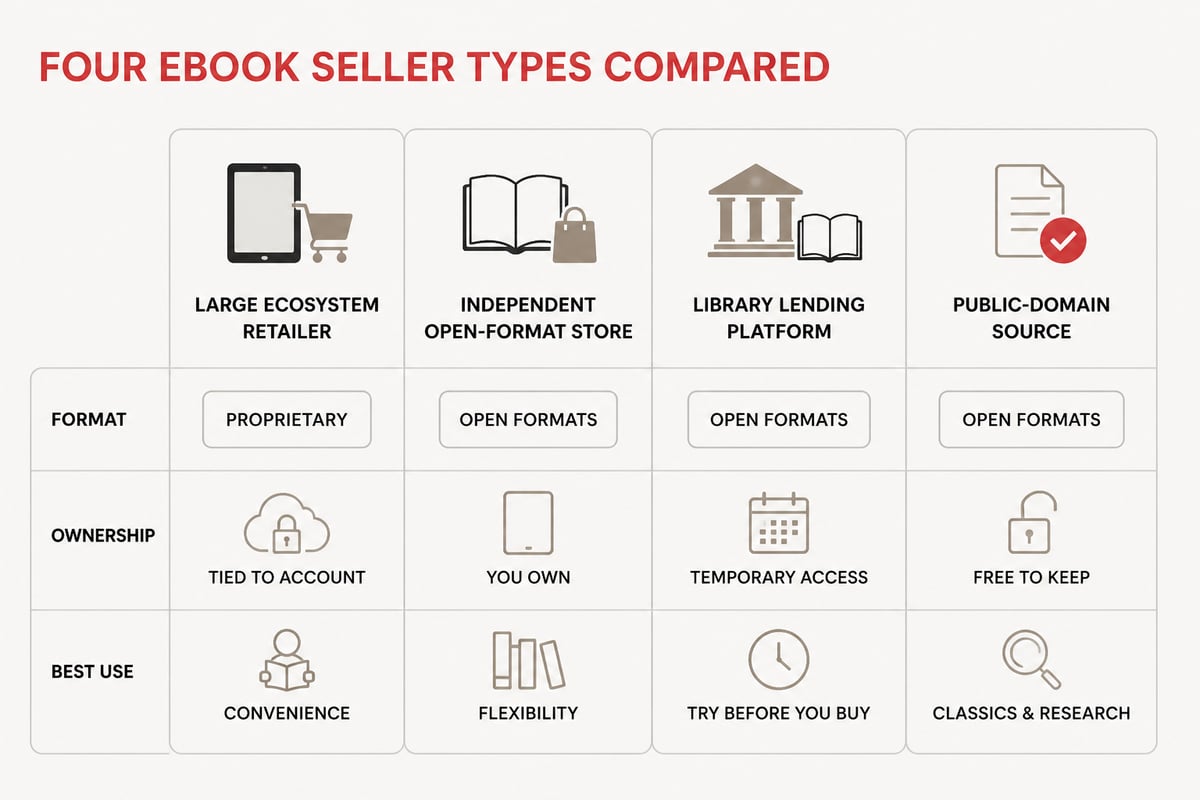
Ebook sellers fall into four groups: large retailers with proprietary ecosystems, independent open-format stores, library lending platforms, and free public-domain sources. Each suits a different reading style, and many readers use more than one. A common pattern is to borrow from a library first, buy the keepers from an open-format store, and pull classics from a public-domain source at no cost.
| Seller type | Typical format | Ownership | Best used for |
|---|---|---|---|
| Large ecosystem retailer | Often proprietary | License tied to one app or device | Readers committed to a single device |
| Independent open-format store | EPUB, sometimes PDF | File you download and keep | Readers who want portability and lower prices |
| Library lending platform | Time-limited loan | Returned after the loan period | Trying a book before buying |
| Public-domain source | EPUB, plain text | Free and permanent | Classics and older titles |
Large retailers offer convenience, but the convenience comes with a trade-off. Your library often lives inside their app, and moving to a different reader later can be difficult or impossible. A reader who has bought two hundred titles in one closed ecosystem effectively rents the right to open them there. Library platforms solve a different problem: the loan expires, so they suit one-time reads rather than books you want to annotate or revisit. Public-domain sources are free and permanent, but they cover older works, not current releases. If you want to explore options beyond the closed model, Tell eBook's page on buying ebooks without relying on Amazon outlines how open formats keep your choices flexible.
Why Open EPUB Files Beat Locked Formats
Open EPUB files are the safest long-term purchase because they work across many apps and devices, and you control the file. A locked format can lose value the day you switch hardware or the platform changes its policies.
EPUB reflows text to fit any screen size, lets you adjust fonts and spacing, and is supported by a wide range of readers, including Kobo and Nook devices as well as phone and tablet apps. That breadth matters because readers rarely stay on one device for a decade.
Consider what ownership looks like in practice:
- You purchase a title and download the file.
- You copy it to a folder, a cloud drive, or an external backup.
- You open it in whichever app or e-reader you prefer today.
- You move it to a new device years later without asking anyone's permission.
Tell eBook delivers titles in open EPUB format, so they work on Kobo, Nook, phones, and tablets, and each purchase is yours to keep. If you read on an Amazon device, the store's guide to buying ebooks for Kindle explains how to bring outside purchases into that setup.
How to Pay Less for Ebooks Without Giving Up Quality
You pay less for ebooks by comparing final prices across stores, favoring stores with consistent low pricing, and avoiding paying twice for the same title in different formats. Small savings per book add up quickly for people who finish dozens of books a year.
A few habits help:
- Check the price before you check the cover. The same bestseller can vary noticeably between sellers.
- Buy from a store that prices low every day, rather than waiting for a promotion that may never match the title you want.
- Keep a wishlist so you can buy when a title drops, not when you feel impatient.
- Borrow first when you are unsure. If a book is a gamble, a library loan costs nothing.
For readers focused on price, Tell eBook's Discount eBooks collection offers bestselling titles at lower prices than major retailers, with instant EPUB and PDF download. It is a practical starting point if your goal is to fill a library without overspending.
Where Libraries Fit Into Your Reading Plan
Libraries are a strong companion to buying, not a replacement for it. They let you test a title or read a one-time interest at no cost, and your purchasing budget goes to the books you want to keep.
Digital lending is growing. According to OverDrive, libraries and schools in its global network recorded 820.5 million digital checkouts in 2025, up 10% year over year. Ebooks accounted for 379.4 million of those checkouts, a 3% increase, and public libraries alone logged 737.6 million digital checkouts, up 9%.
Those numbers show how many readers already treat borrowing as part of their routine. The limitation is the loan period: popular titles can have waitlists, and the book disappears when the loan ends. Buying makes sense for any title you may want to reread, annotate, or lend your attention to again.
A simple rule works well. Borrow a title when you are curious, and buy it when you already know you will return to it.
Audiobooks: A Second Reason to Choose a Dual-Format Store
A store that sells both ebooks and audiobooks saves you from managing two accounts and two sets of prices. Many avid readers switch between reading and listening depending on whether they are at a desk, on a commute, or at the gym. A dual-format account also makes it easy to pair formats on a single title: read a chapter at night, then pick up the audio version the next morning while you get ready for work, without hunting for the book in a second store.
Look for these features in a dual-format store:
- Instant download for audio files as well as text
- Clear categories so you can find the same genre in either format
- No subscription requirement to keep what you bought
- Titles that you can play on a phone or tablet without special hardware
Price comparison matters here more than many buyers expect, because audiobooks usually cost more per title than ebooks. Checking the final price of an audio edition at two sellers can save a meaningful amount over a year of listening. It also helps to confirm that audio files download to your device as files, so you can back them up the same way you back up your EPUB collection.
Tell eBook offers audiobooks alongside ebooks, and its guides to the best audiobooks of 2026 and talking books can help you choose a first listen. Pairing the same author in both formats is a pleasant way to continue a story when your eyes need a break.
A Short Checklist Before You Buy
Run any ebook store through a short checklist before you spend money. It takes two minutes and prevents most regrets.
- Confirm the file format. EPUB is the safest choice for portability.
- Compare the price of two or three titles you want against another seller.
- Read the ownership terms. You should be able to keep and back up your purchase.
- Check delivery. Digital purchases should arrive instantly, with no shipping charge.
- Browse your genres. Make sure your favorite categories are well stocked.
- Test one purchase before you commit to a large order.
If a store passes all six, you can buy with confidence. Tell eBook's catalog spans fiction, business, comics, and biographies, so a single account can cover most reading moods. You can browse examples such as Buying a Better World: George Soros and Billionaire Philanthropy for business and biography readers, or Inner Places: The Life of David Milne for those who prefer an artist's life story.
Building a Library You Will Still Use in Ten Years
The best ebook library is one organized from the first purchase, stored in a format that will outlast any single app. Habits matter as much as the store you choose.
Start by keeping a master folder of purchased files, organized by author or genre. Back it up to a second location, such as an external drive or a cloud service you trust. Use a reader that imports EPUB files directly so your library is never trapped inside one vendor's interface.
Learning is a natural use for a personal library too. Students and lifelong learners often pair a purchased collection with institutional resources, such as their school's digital library, to cover both leisure and academic reading. If you study from textbooks, Tell eBook's page on buying etextbooks shows the digital options available.
Readers with other passions can build around them. A cyclist might keep training and biography titles close at hand while planning gear from a specialist cycling apparel maker. A well-sorted library makes it easy to find the right book for any interest, whether you want a quick read after a ride or a long biography for a weekend.
Frequently Asked Questions
Is an independent store really the best place to buy ebooks?
For readers who value lower prices and open files, yes. An independent store that sells EPUB downloads gives you portability that a closed ecosystem does not, and the savings on frequent purchases are noticeable.
Can I read EPUB files on a Kindle or other devices?
EPUB works on Kobo, Nook, phones, and tablets through free reading apps.
Do I lose my books if a store closes?
If you downloaded the file and backed it up, no. That is the main advantage of owning a file rather than renting access inside an app.
How do I find the lowest price on a specific title?
Compare the final checkout price at two or three sellers and check a dedicated deals page. Tell eBook's best book price page is one place to start.
Should I buy ebooks or borrow them?
Do both. Borrow to sample, and buy the titles you expect to reread or want to keep permanently.
Pick one title you have been meaning to read, compare its price at two stores, and download it in EPUB format so you can test the experience on your own device. When you are ready to build a library at lower prices, you can browse fiction, business, comics, biographies, and audiobooks at Tell eBook and go to the shop to start filling your shelves: Go to Shop.