

An ebook store is an online retailer where you buy digital books, download them instantly, and read them on a phone, tablet, e-reader or computer. The best choice depends on three things: the file format you receive, the price you pay, and whether you actually own the book once the purchase is complete.
The market for digital books is steady and growing. According to Publishing Perspectives, reporting the AAP annual StatShot, U.S. trade ebook revenue increased in 2025 compared with 2024, and ebook revenue rose across the five years from 2021 to 2025. For avid readers, that means more titles, more competition on price, and more places to shop.
What Is an Ebook Store and How Does It Work?
An ebook store is a digital storefront that sells books as downloadable files rather than printed copies. You browse a catalog, pay at checkout, and receive a file you can open in a reading app or on a dedicated e-reader.
The process is short:
- Search or browse by category, author or title.
- Add the book to your cart and pay.
- Download the file immediately, with no shipping fees or waiting.
- Open it in a compatible reading app or device.
- Keep it in your library for as long as you like.
Most stores also sell audiobooks alongside ebooks, which lets you move between reading and listening depending on your day. A commute suits audio. An evening suits a screen or an e-ink display.
The details that separate one store from another are file format, digital rights management (DRM), pricing and catalog depth. The sections below cover each one.
The Main Types of Ebook Stores
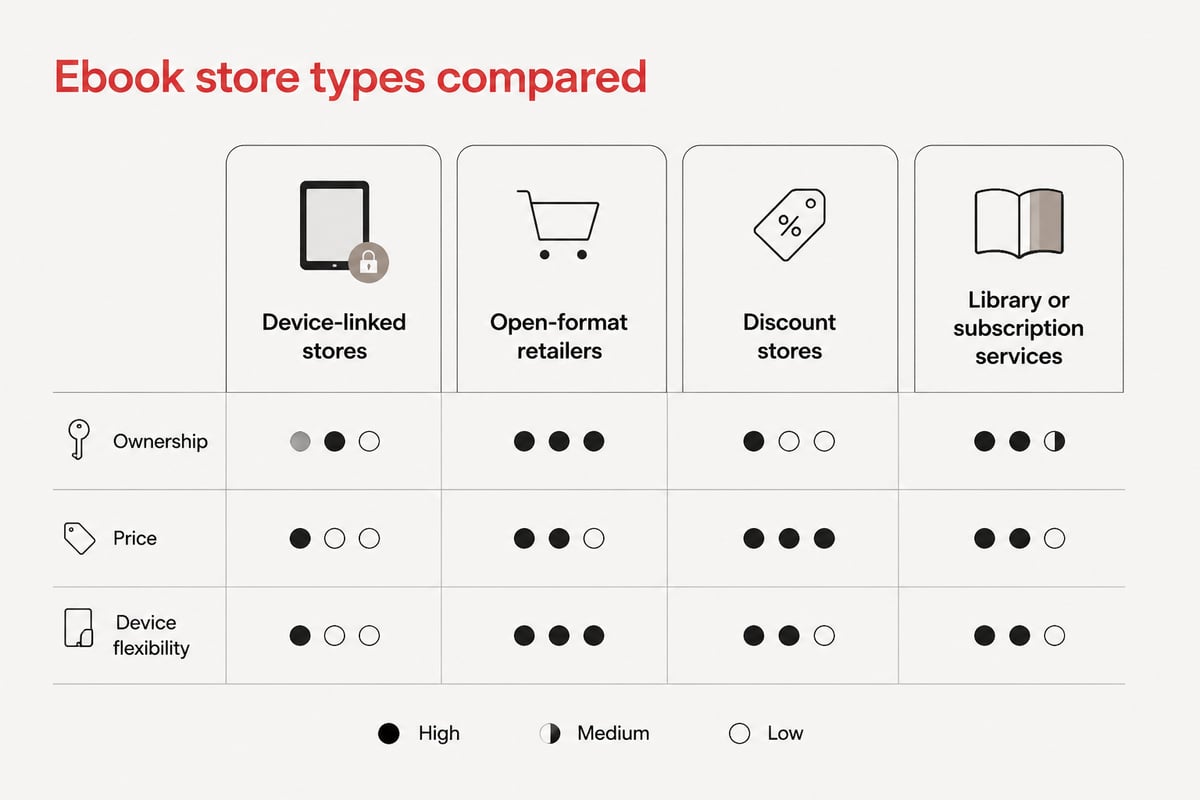
Online ebook retailers fall into four broad groups, and each serves a different kind of reader.
Device-Linked Stores
These are run by the companies that make e-readers and reading apps. Their advantage is convenience: purchases appear on your device within seconds. The tradeoff is that your library may be tied to one ecosystem, which can make switching devices harder later. If you want to understand how these storefronts compare with open alternatives, Tell eBook's overview of the Kindle store and its guide to a Kobo bookstore explain the practical differences.
Independent and Open-Format Retailers
These stores sell books in open formats that work across many apps and devices. They tend to appeal to readers who dislike being locked into a single platform. If you want a library you can move between devices, an EPUB bookstore is the category to look at.
Discount and Deal-Focused Stores
These retailers compete on price. Some run permanent low pricing, others rely on rotating promotions. For readers who finish several books a month, the savings add up quickly, and a store with consistently lower prices can matter more than a slightly larger catalog.
Library and Subscription Services
Lending apps and subscription plans let you borrow or stream rather than own. They suit readers who sample widely. They are less suited to people who want a permanent collection they can reread or reference years later.
File Formats: Why EPUB Matters When Choosing an Ebook Store
EPUB is the most widely supported open ebook format, and choosing a store that delivers it keeps your options open. The W3C’s EPUB overview describes how EPUB uses reflowable text, so a page adapts to your screen size and your preferred font size rather than staying fixed.
That flexibility is practical. Increase the type size on a small phone, switch to a serif font on a tablet, or adjust margins on an e-reader, and the book reflows cleanly each time.
Here is how the common formats compare:
| Format | Best for | Notes |
|---|---|---|
| EPUB | Novels, nonfiction, biographies | Reflowable, open standard, broad app support |
| Fixed-layout documents, art books | Keeps page layout, harder to read on small screens | |
| Proprietary store formats | Readers committed to one ecosystem | Often limited to a single brand's apps and devices |
Accessibility is another reason to favor EPUB. The W3C EPUB Accessibility 1.1 standard describes conformance requirements and metadata that help readers identify accessible publications. If you rely on screen readers, text resizing or other assistive features, check whether a store or publisher provides that information.
How to Compare Prices and Value
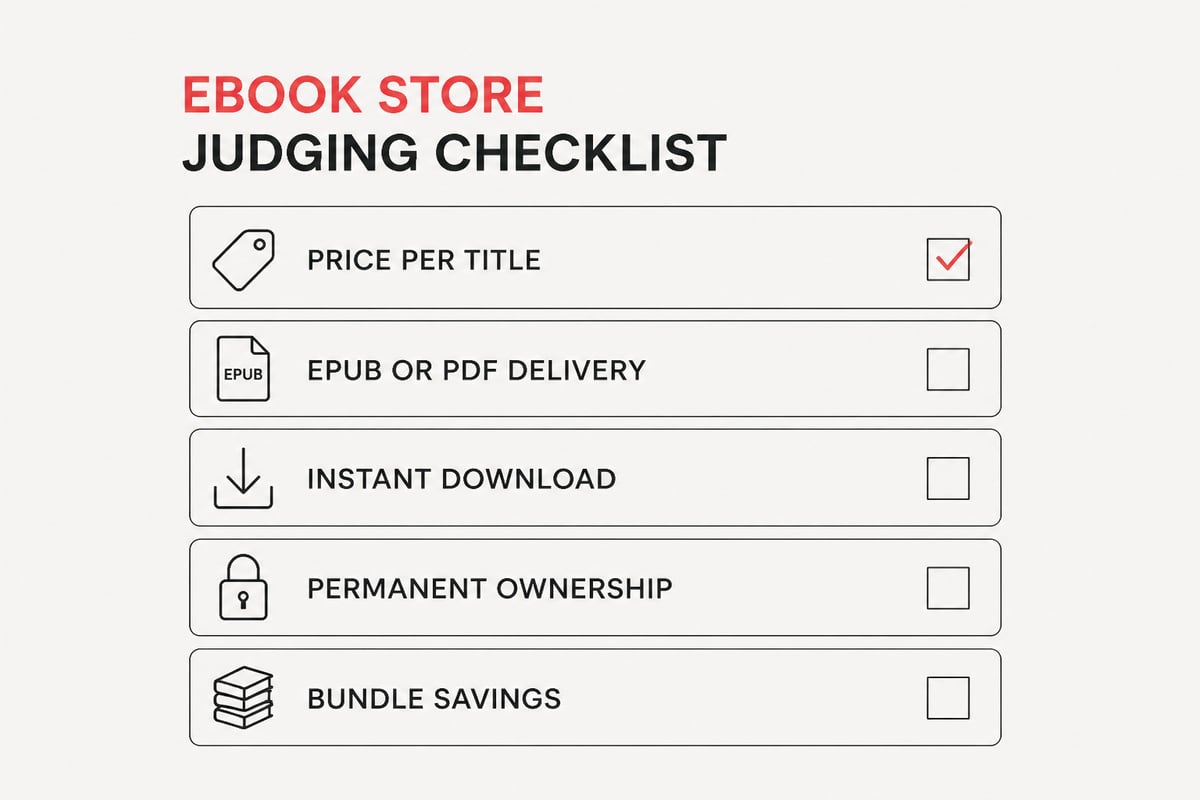
The sticker price is only one part of value, so compare stores on four points before you buy.
- Price per title. Check the same book across two or three stores. Differences of a few dollars per book become significant over a year of reading.
- Ownership. Confirm that you keep the file after purchase. Buying once and keeping a book forever is the baseline you should expect.
- Delivery. Instant download with no waiting is standard, but confirm there are no hidden fees.
- Compatibility. A cheap file that only opens in one app is not a bargain if you later change devices.
Bundles deserve attention too. A multi-book set often costs less per volume than buying each title separately. A collection such as Frank Herbert’s Dune Saga Collection, Books 1-6 gives a reader six novels in a single purchase, which suits anyone who wants to read a series straight through.
The overall market context helps explain why discounting is common. Publishing Perspectives reports that digital formats generated a substantial share of U.S. trade-publishing revenue in 2025, and that digital also represented a meaningful portion of U.S. publisher revenue across all categories. With digital making up such a large part of the business, retailers have a strong reason to compete for regular buyers.
Where Discounts Come From
The lowest prices usually come from stores built around value rather than from temporary sales. Discount eBooks at Tell eBook offers bestselling titles at lower prices than major retailers, with instant EPUB and PDF download, which makes it a practical option for readers who buy often and want to stretch a book budget.
Pricing power also reflects the market itself. Because digital formats make up a large share of U.S. trade-publishing revenue, retailers know that a reader who finds a reliable low-price source tends to return, and discounting is how stores earn that repeat business. A store that undercuts competitors on bestsellers can win a reader's entire monthly book budget, not just a single sale.
Beyond choosing a discount-minded store, a few habits lower your spending:
- Wait for a price drop on a book you do not need immediately.
- Buy series as bundles instead of one book at a time. Six novels in one purchase, such as the Dune Saga set mentioned earlier, cost less per volume than six separate checkouts.
- Read samples before purchasing to avoid paying for a book that does not suit you.
- Keep a short wish list so you can buy when a title is at its lowest price.
Choosing a Store by Reading Habits
The right ebook store matches how you read, so start with your habits and work backward to a retailer.
If you favor biographies and history, depth of catalog matters most. Titles like Becoming Steve Jobs and Benjamin Franklin: The First American sit in a category where backlist breadth is the main draw. Look for a store with a strong biography section and clear category navigation.
If you read business titles, look for stores that group books by topic and let you preview content before buying, since business books vary widely in quality and focus.
If you read comics and graphic works, check that the store handles fixed-layout files well, because panel-based pages do not always behave like flowing text.
If you split time between reading and listening, a store that sells ebooks and audiobooks together simplifies your library. You can pick up a story in audio on a walk and finish it as text at night, all under one account.
What to Check Before You Buy From Any Ebook Store
A short review before your first purchase prevents most problems later. Run through these questions:
- What format will I receive? Prefer open formats such as EPUB. A reflowable file adapts to any screen, while a locked proprietary format may open in only one app.
- Do I own the file? A permanent download beats a license that can expire. Look for plain wording such as "buy once, keep forever" on the product or help page.
- Will it open on my devices? Confirm support for your phone, tablet and e-reader, and check whether you can read on a computer too.
- Is the price final? Look for taxes or fees added at checkout, and compare the total, not the listed price.
- Is the catalog broad enough? Search for three or four authors you already read. If most are missing, the store will frustrate you quickly.
- Does the store sell audiobooks? This matters if you listen as well as read, since one account for both keeps your library in one place.
Take a moment to test the checkout with a low-priced title first. It costs little and shows you exactly how download, file format and device compatibility work in practice. Open the file on every device you own before buying more, and save a backup copy right away.
Building a Library You Can Keep for Years
A good ebook store gives you a library that outlasts any single device. Open formats, permanent ownership and local backups are what make that possible.
Download your purchases rather than relying only on cloud access, and keep a copy on a computer or external drive. Because EPUB files are open, they travel with you from an old tablet to a new phone without conversion or loss. This is the quiet advantage of buying from stores that deliver standard files: the books remain yours regardless of which hardware or app you prefer next year.
Organization helps as the collection grows. Sort by author, series or genre, and use your reading app's collections feature so a 300-book library stays easy to browse. Titles such as Andrew Carnegie by David Nasaw or Leonardo: Insatiable Curiosity become reference reading you return to, which is another reason to favor ownership over rental.
Readers who also care about staying organized beyond their shelves may like the minimalist planning templates at Easlo, which can help track a reading list, goals and finished titles in one place.
Frequently Asked Questions About Buying Ebooks Online
Is it safe to buy from an online ebook store?
Yes, provided the store uses secure checkout and a recognizable payment method. Check for a clear returns or support policy and confirm what format you will receive before paying.
Can I read ebooks on any device?
Most can be read on phones, tablets, computers and many e-readers, but compatibility depends on the format. EPUB works across a wide range of apps and devices, which is why it is the safest default.
Do I keep the ebooks I buy?
That depends on the store. Look for a clear statement that you buy once and keep the book forever, and download the file so you hold your own copy.
Are ebooks cheaper than printed books?
Often, though not always. Discount-focused stores frequently price bestsellers below major retailers, and bundles lower the per-book cost further.
What is the difference between EPUB and PDF?
EPUB reflows text to fit your screen and font size, which suits long-form reading. PDF preserves a fixed page layout, which suits documents and art books but is less comfortable on small screens.
Start by picking one book you want to read next and compare its price and file format across two stores before you buy. If you want bestsellers at lower prices, instant EPUB delivery and a library you keep permanently, browse the fiction, business, comics and biography sections at Tell eBook, where you can go to the shop and have your next ebook or audiobook downloading in minutes.