

The digital publishing landscape has transformed dramatically over the past decade, with EPUB emerging as the dominant format for distributing ebooks across platforms and devices. For businesses entering the digital book retail space, understanding how to build and operate an effective epub bookstore requires navigating technical standards, distribution protocols, and reader expectations. Whether you're launching a specialized niche store or a comprehensive digital library, the foundation lies in delivering properly formatted content through reliable systems that serve readers wherever they choose to consume their books.
Understanding the EPUB Format Foundation
The EPUB format serves as the universal standard for digital books, providing a flexible container that adapts to different screen sizes and reading preferences. The W3C Recommendation for EPUB 3.3 defines the current specification, incorporating modern web technologies while maintaining backward compatibility with older reading systems.
An effective epub bookstore must prioritize file quality and conformance. Publishers and retailers rely on validation tools to ensure files meet specification requirements before distribution. The EPUBCheck validation tool has become the industry standard for verifying file integrity, checking everything from structural elements to metadata completeness.
Core Technical Requirements
Building a robust epub bookstore infrastructure demands attention to several technical components:
- File validation pipelines that automatically check every title before publication
- Metadata management systems that track ISBNs, pricing, DRM policies, and rights information
- Storage architecture designed for efficient delivery of files ranging from 500KB to 50MB
- Version control systems that maintain multiple editions and format variations
The technical foundation determines operational efficiency. Automated quality checks prevent distribution of corrupted files, while comprehensive metadata enables accurate search and discovery features that readers expect from modern bookstores.

Catalog Distribution and Discovery Systems
Modern readers expect to discover books through multiple channels, making catalog distribution a critical component of any epub bookstore strategy. The Open Publication Distribution System specifications provide standardized protocols for exposing book catalogs to reading applications, library systems, and aggregator services.
| Distribution Method | Primary Benefit | Implementation Complexity |
|---|---|---|
| OPDS Feed | Universal compatibility | Medium |
| REST API | Custom integration flexibility | High |
| RSS/Atom | Simple syndication | Low |
| Schema.org markup | Search engine visibility | Low |
OPDS feeds enable reading applications to browse and download books directly from your store, creating seamless user experiences that keep readers engaged within their preferred reading environments. Implementing Schema.org Book properties enhances search engine visibility, allowing potential customers to discover titles through organic search results.
Search and Discovery Features
Readers navigate large collections through sophisticated search capabilities. Essential features include:
- Full-text metadata search across titles, authors, descriptions, and subject categories
- Faceted filtering by genre, publication date, price range, and format type
- Recommendation engines based on purchase history and browsing behavior
- Curated collections highlighting seasonal themes, staff picks, or promotional campaigns
- Preview functionality allowing readers to sample content before purchase
The epub.js rendering library enables browser-based previews, letting customers read sample chapters without downloading files or leaving your storefront. This reduces friction in the purchase decision process while showcasing content quality.
Format Variants and Specialty Content
While reflowable text remains the standard for most fiction and non-fiction titles, an epub bookstore serving diverse audiences must accommodate specialty formats. The BISG Field Guide to Fixed Layout provides crucial guidance for handling children's books, graphic novels, cookbooks, and illustrated works that require precise layout control.
Fixed-layout EPUBs present unique challenges in catalog management and customer communication. Clear labeling helps readers understand device compatibility and reading experience differences between reflowable and fixed-layout titles.
Managing Multiple Format Versions
Comprehensive stores often maintain several format variations for individual titles:
- Standard reflowable EPUB for general-purpose reading
- Fixed-layout EPUB for illustrated or design-intensive content
- PDF versions for print-fidelity requirements
- Audiobook editions synchronized with text versions
- Large-print or accessibility-enhanced editions
Version management systems track relationships between editions, ensuring customers receive appropriate formats for their devices and preferences. Platforms like Tell eBook demonstrate effective multi-format strategies, offering both ebook and audiobook editions across diverse categories including fiction, business, comics, and biographies.

Reading System Integration and Compatibility
The Readium project provides open-source components that power many commercial reading applications, from dedicated ebook readers to browser-based platforms. Understanding this ecosystem helps epub bookstore operators ensure compatibility across the fragmented landscape of reading devices and applications.
Testing protocols should verify rendering accuracy across representative devices:
- E-ink devices (Kindle, Kobo, Nook) with limited display capabilities
- Tablet applications (iOS Books, Google Play Books) with rich media support
- Desktop readers (Adobe Digital Editions, Calibre) with advanced typography
- Web-based readers using epub.js or similar rendering engines
Each platform handles EPUB features differently, creating variance in user experience. Comprehensive quality assurance identifies rendering issues before they affect customer satisfaction.
DRM and Distribution Rights
Digital rights management remains contentious in ebook retail. Consider the tradeoffs:
| Approach | Customer Experience | Piracy Risk | Platform Lock-in |
|---|---|---|---|
| No DRM | Excellent | High | None |
| Adobe DRM | Moderate | Low | Moderate |
| Proprietary DRM | Poor | Very Low | Severe |
| Social DRM | Good | Medium | None |
Many successful epub bookstore operators have found that eliminating DRM increases customer satisfaction and loyalty while marginally increasing unauthorized sharing. Social DRM watermarking provides accountability without restricting legitimate use.
Accessibility and Preservation Standards
The Library of Congress Digital Formats guidance emphasizes EPUB's role as both a distribution and preservation format. Building accessibility features into your epub bookstore serves readers with disabilities while future-proofing your catalog.
Essential accessibility features include:
- Semantic HTML structure enabling assistive technology navigation
- Alternative text for all images and visual elements
- ARIA landmarks identifying content regions and navigation
- Text-to-speech compatibility through clean, properly tagged content
- Adjustable typography respecting user font and spacing preferences
Accessible content expands your addressable market while demonstrating commitment to inclusive reading experiences. Many jurisdictions now mandate accessibility in digital publications, making these features legal requirements rather than optional enhancements.
Long-term Archive Strategies
Digital preservation extends beyond initial publication. Effective strategies include:
- Maintaining master files in archival formats with comprehensive metadata
- Regular migration to updated EPUB specifications as standards evolve
- Redundant storage across geographically distributed systems
- Documented conversion pipelines enabling future format migrations
- Relationships with digital preservation consortia for institutional backup
These practices protect both your business assets and customer access to purchased content over decades rather than years.
Pricing Models and Revenue Optimization
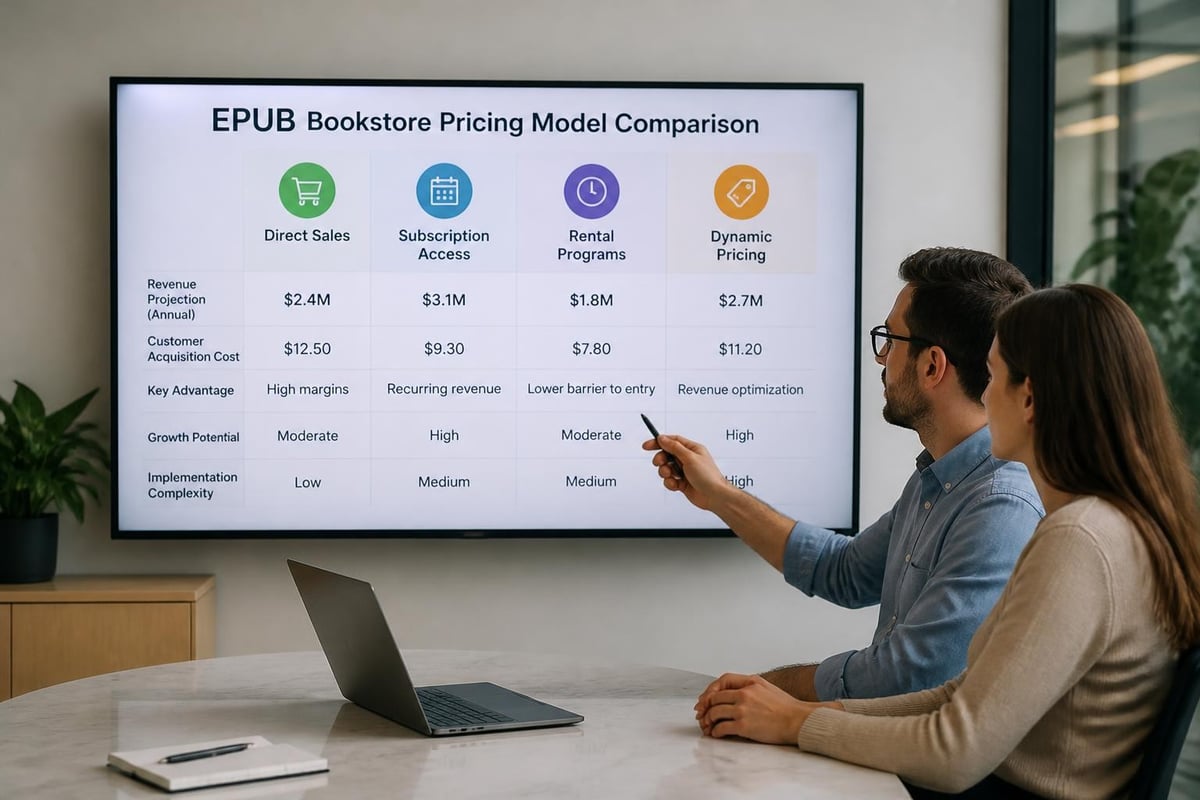
Successful epub bookstore operations balance competitive pricing with sustainable margins. Revenue models include:
Direct Sales: Traditional retail transactions with fixed pricing provide predictable revenue but face intense price competition from major platforms.
Subscription Access: All-you-can-read models generate recurring revenue but require large catalogs to maintain perceived value.
Rental Programs: Time-limited access at reduced prices appeals to price-sensitive readers while encouraging repeat transactions.
Dynamic Pricing: Algorithmic price adjustments based on demand, inventory age, and competitive positioning maximize revenue across catalog depth.
Platforms offering discount eBooks with bestselling titles at lower prices than major retailers demonstrate how competitive pricing strategies attract price-conscious readers while maintaining margin through volume and operational efficiency.
Marketing and Customer Acquisition
Digital book retail requires sophisticated marketing across multiple channels. Effective strategies include:
- Content marketing through author interviews, reading guides, and genre-focused editorial
- Email campaigns highlighting new releases, seasonal promotions, and personalized recommendations
- Social media engagement building communities around specific genres or reading interests
- Affiliate partnerships with book bloggers, reviewers, and reading communities
- Paid advertising targeting specific demographics through search, social, and display networks
Customer acquisition costs in ebook retail typically range from $8 to $25 depending on channel and targeting precision. Lifetime value calculations must account for repeat purchase rates, which vary significantly by genre and reader demographics.
Building Reader Loyalty
Retention strategies prove more cost-effective than constant acquisition:
- Personalized recommendations based on purchase history and browsing behavior
- Early access programs giving loyal customers first access to anticipated releases
- Reader rewards programs providing discounts or free titles based on purchase volume
- Curated newsletters matching content to individual reading preferences
- Community features enabling reviews, ratings, and reader discussions
Engaged readers purchase more frequently and demonstrate higher lifetime value, justifying investment in retention-focused features and communications.
Operational Excellence and Customer Service
Technical infrastructure must support reliable file delivery regardless of traffic spikes during major releases or promotional campaigns. Architecture considerations include:
Content Delivery Networks: Geographic distribution reduces latency and improves download speeds for customers worldwide.
Redundant Storage: Multiple backup systems protect against data loss and enable rapid recovery from system failures.
Monitoring Systems: Real-time tracking of download success rates, page load times, and error conditions enables proactive problem resolution.
Customer Support Integration: Ticketing systems connecting to order history and file delivery logs streamline troubleshooting.
Response time expectations have compressed in 2026, with readers expecting instant downloads and sub-second page loads. Infrastructure investment must match these expectations to remain competitive.
Returns and Refund Policies
Digital goods present unique refund challenges since consumption occurs instantly. Balanced policies consider:
| Scenario | Standard Approach | Customer Satisfaction Impact |
|---|---|---|
| Technical failure | Full refund + replacement | Positive |
| Wrong title purchased | Store credit within 24 hours | Neutral |
| Dissatisfaction with content | Limited refund window | Variable |
| Duplicate purchase | Automatic refund detection | Positive |
Clear communication about refund policies during checkout prevents disputes while managing expectations around digital goods characteristics.
Analytics and Business Intelligence
Data-driven decision making separates successful epub bookstore operations from struggling competitors. Essential metrics include:
- Conversion rates from browsing to purchase across traffic sources
- Average order value and trends over time
- Genre performance identifying high-margin categories worth expanding
- Customer acquisition costs by channel enabling budget optimization
- Repeat purchase rates indicating catalog strength and loyalty effectiveness
Advanced analytics reveal patterns in browsing behavior, abandoned cart recovery opportunities, and optimal pricing thresholds for different title types. Integration with catalog management enables automated inventory decisions based on performance data.
Competitive Intelligence
Market positioning requires understanding competitor offerings and pricing. Monitoring tools track:
- Pricing trends across competing stores for comparable titles
- New release timing and promotional calendars
- Genre expansion and catalog growth patterns
- Customer review sentiment and satisfaction indicators
- Marketing message positioning and value propositions
This intelligence informs strategic decisions about catalog development, pricing adjustments, and marketing focus.
Future-Proofing Your EPUB Bookstore
The digital publishing landscape continues evolving with emerging technologies and changing reader expectations. Forward-looking operators monitor developments in:
Enhanced Media Integration: Future EPUB specifications will likely expand support for interactive elements, embedded video, and sophisticated animation beyond current capabilities.
Artificial Intelligence: Machine learning applications in recommendation engines, metadata generation, and content categorization will become table stakes rather than differentiators.
Blockchain and NFTs: Digital ownership models may evolve to include verifiable unique editions and transferable licenses, though mainstream adoption remains uncertain.
Voice Interfaces: Audio-first discovery and consumption patterns require adaptation of traditional text-based catalog systems.
Flexibility in technical architecture enables adoption of emerging capabilities without complete system rebuilds. Modular design and well-documented APIs facilitate integration of new features as market demands evolve.
Building a successful epub bookstore requires balancing technical excellence with customer-focused service delivery, ensuring readers can discover, purchase, and enjoy content seamlessly across their preferred devices and platforms. Tell eBook demonstrates this approach by offering carefully curated ebook and audiobook collections with instant downloads and competitive pricing across diverse categories from fiction to biography. Whether you're exploring curated biography selections or discovering classic science fiction, the right epub bookstore combines technical reliability with passionate curation to serve readers' evolving needs.