

The digital reading market has transformed dramatically over the past decade, and understanding ebook prices has become essential for both publishers and consumers. Whether you're browsing for your next thriller, exploring business titles, or diving into graphic novels, pricing varies significantly across formats, genres, and platforms. The landscape of digital publishing continues to evolve, with new pricing models emerging and consumer expectations shifting. As readers become more discerning about value and selection, knowing what influences the cost of digital books helps everyone make better purchasing decisions.
The Current State of eBook Pricing in 2026
Digital book pricing has stabilized considerably compared to the wild fluctuations seen in earlier years. Today, most ebooks fall within predictable price ranges based on specific factors that publishers and independent authors carefully consider.
Average Price Ranges by Category:
- Fiction bestsellers: $9.99 to $14.99
- Indie fiction: $2.99 to $6.99
- Business and professional: $12.99 to $24.99
- Academic and technical: $29.99 to $99.99
- Comics and graphic novels: $4.99 to $12.99
The average cost of an ebook in 2026 reflects a mature market where consumers understand the value proposition of digital formats versus physical books. Unlike print editions that carry production and shipping costs, ebook prices are primarily influenced by content value, author reputation, and market positioning.
Platform Policies Shape Retail Costs
Amazon's Kindle Direct Publishing continues to dominate the market, and their pricing structure significantly influences how ebook prices are set across the industry. The platform offers two primary royalty options: 35% for books priced outside the $2.99 to $9.99 range, and 70% for titles within that sweet spot.
Understanding how Amazon Kindle pricing works reveals why so many titles cluster around $4.99 and $9.99 price points. Publishers maximize their earnings while keeping prices attractive to readers. This creates a competitive environment where strategic pricing becomes as important as quality content.

Genre-Based Pricing Strategies
Different literary categories command vastly different price points, reflecting production effort, target audience purchasing power, and market expectations. Romance readers, for instance, consume books rapidly and prefer lower price points that enable frequent purchases. Business readers, conversely, view professional development titles as investments and accept higher costs.
| Genre Category | Typical Range | Reader Expectations | Volume Potential |
|---|---|---|---|
| Romance | $2.99 – $5.99 | High volume, frequent purchases | Very High |
| Mystery/Thriller | $4.99 – $9.99 | Moderate volume | High |
| Science Fiction/Fantasy | $4.99 – $12.99 | Series investment | Moderate-High |
| Business/Self-Help | $9.99 – $19.99 | Premium value | Moderate |
| Literary Fiction | $9.99 – $14.99 | Quality over quantity | Moderate |
Fiction genres generally maintain lower ebook prices to encourage volume sales and series adoption. A reader who discovers an author at $3.99 for book one might purchase the entire series, generating more total revenue than a single higher-priced standalone title.
Nonfiction Commands Premium Positioning
Professional and educational content typically carries higher price tags because readers seek specific solutions or specialized knowledge. Factors that influence the price of ebooks include research depth, author credentials, and practical applicability. A comprehensive business strategy guide priced at $19.99 still offers tremendous value compared to a consulting session or professional course.
Technical manuals, programming guides, and academic texts often exceed $29.99 because they serve narrow professional audiences willing to pay for authoritative information. These titles compete with traditional textbooks that cost substantially more, making even premium-priced ebooks appear affordable.
Length and Production Value Considerations
Book length directly impacts perceived value and appropriate pricing. A 50,000-word romance novel and a 150,000-word epic fantasy shouldn't carry identical price tags, yet many authors overlook this fundamental principle.
Word Count Pricing Guidelines:
- Novellas (20,000-50,000 words): $0.99 – $3.99
- Standard novels (50,000-90,000 words): $3.99 – $9.99
- Long novels (90,000-120,000 words): $6.99 – $12.99
- Epic length (120,000+ words): $9.99 – $14.99
Readers instinctively recognize value in substantial content. When browsing platforms like Tell eBook, consumers compare page counts, reviews, and prices to assess whether a title merits its asking price. A 700-page fantasy epic at $9.99 represents hours of entertainment, while a 150-page novella at the same price might seem overpriced.
Production Quality Matters
Professional editing, cover design, and formatting contribute to production costs that publishers factor into ebook prices. Traditionally published titles often cost more because they include investments in marketing, editing teams, and established distribution networks. Independent authors who cut corners on production quality typically price lower to compensate for perceived reduced value.
Comics and graphic novels present unique pricing challenges because their visual content requires different production skills. Full-color illustrations, lettering, and panel layouts demand specialized talent, justifying higher prices than text-only formats. Readers understand this value proposition and accept premium pricing for well-executed graphic storytelling.

Publisher Type and Pricing Models
The gap between traditional publishing and independent authors significantly affects ebook prices across the marketplace. Big Five publishers leverage established author brands and extensive marketing budgets to maintain premium pricing, while indie authors often compete on price to build readership.
Traditional publishers typically resist aggressive discounting because they protect print sales and maintain brand prestige. Their ebooks rarely drop below $9.99 for new releases, creating opportunities for independent authors to undercut them on price while building loyal audiences.
Agency vs. Wholesale Models
Publishing contracts determine whether publishers or retailers control final pricing. Under the agency model, publishers set prices and retailers receive fixed commissions. The wholesale model allows retailers like Amazon to discount freely, purchasing books at wholesale rates and setting retail prices independently.
eBook pricing models and distribution channels significantly impact what consumers ultimately pay. When Amazon controls pricing through wholesale agreements, they frequently discount bestsellers to attract customers, sometimes selling below their acquisition cost to drive platform traffic.
Promotional Pricing and Psychological Anchoring
Strategic discounting has become standard practice in digital publishing. Limited-time promotions create urgency, while permanent price reductions help older titles find new audiences. The key lies in establishing proper price anchoring-ensuring readers perceive value even at discounted rates.
Common Promotional Strategies:
- New release pricing at $0.99-$2.99 to build reviews and visibility
- First-in-series discounts to drive subsequent purchases
- Seasonal promotions aligned with holidays or reading trends
- Bundle pricing for series collections
- Limited-time flash sales during promotional events
The psychology behind $4.99 versus $5.00 remains powerful. That one-cent difference signals value-conscious pricing and triggers different mental accounting in buyer decision-making. Most successful ebooks use 99-cent endings precisely because they test better in conversion metrics.
Launch Strategies and Long-Term Positioning
Many authors employ graduated pricing strategies, launching at low introductory prices to generate reviews and visibility, then increasing to sustainable levels once the book establishes market presence. This approach builds momentum while avoiding the permanent low-price trap that some authors fall into.
Pricing an ebook for maximum sales requires balancing immediate volume against long-term revenue goals. A $0.99 launch might generate thousands of downloads and reviews, creating social proof that supports future sales at $5.99 or higher.
Platform-Specific Pricing Considerations
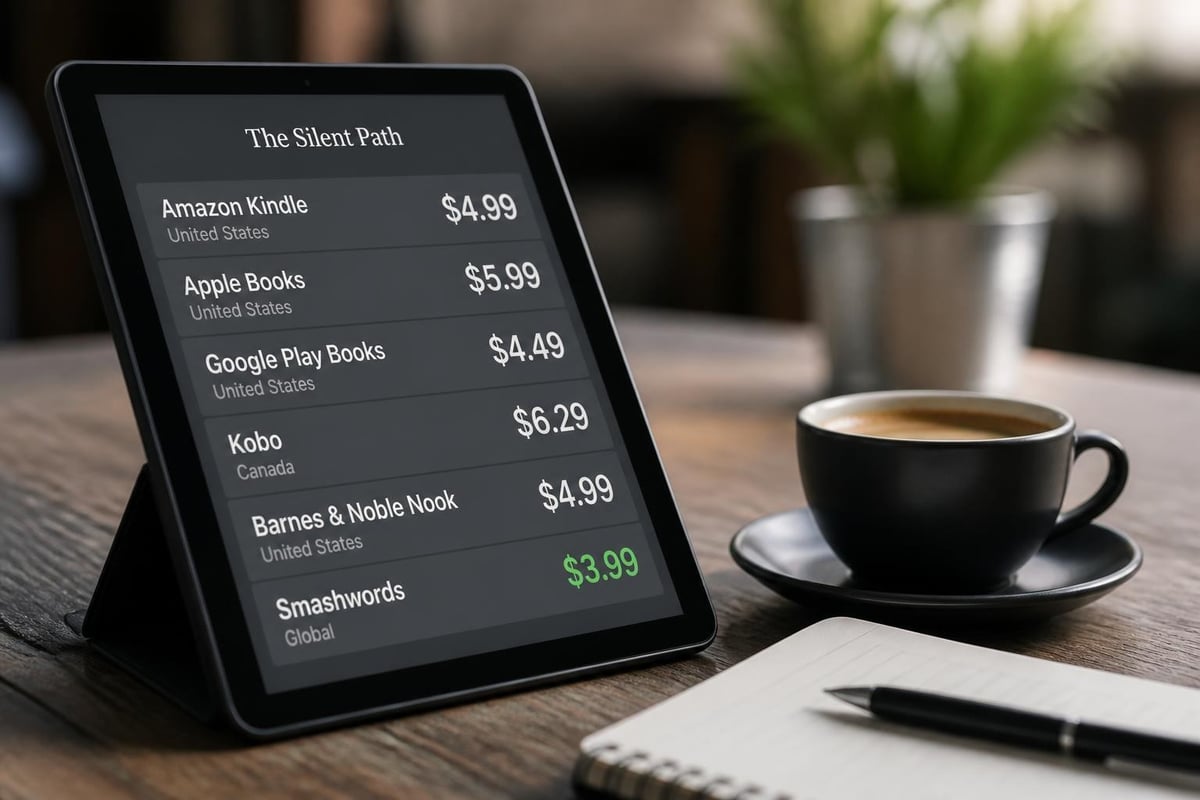
Amazon dominates digital book sales, but exclusive focus on Kindle pricing ignores significant opportunities across Apple Books, Google Play, Kobo, and other platforms. Each marketplace has unique pricing dynamics and customer expectations.
| Platform | Market Share | Pricing Sweet Spot | Key Consideration |
|---|---|---|---|
| Amazon Kindle | 65-70% | $2.99 – $9.99 | Royalty tiers drive pricing |
| Apple Books | 10-12% | $4.99 – $12.99 | Premium audience |
| Google Play Books | 5-7% | $3.99 – $9.99 | International reach |
| Kobo | 8-10% | $3.99 – $9.99 | Strong non-US markets |
International markets add complexity to ebook prices because purchasing power varies dramatically by region. A $9.99 ebook represents different value propositions in the United States, India, and Brazil. Smart publishers adjust regional pricing to match local market conditions while maintaining consistent positioning.
Subscription Services and Perceived Value
Kindle Unlimited, Scribd, and other subscription services have fundamentally altered how readers perceive ebook prices. When consumers access unlimited reading for $11.99 monthly, individual book prices above $9.99 face higher resistance. This shift has pushed many authors toward enrollment in these programs, trading per-sale revenue for page-read payments.
The subscription model benefits voracious readers who consume multiple titles monthly. For platforms like Tell eBook that offer diverse selections across fiction, business, comics, and biographies, understanding how subscriptions influence purchasing behavior helps curate collections that appeal to both buyers and borrowers.
Testing and Optimization
Determining the optimal price for an ebook involves systematic testing rather than guesswork. Successful publishers experiment with different price points, measuring conversion rates, total revenue, and ranking performance at each level. A book that sells 100 copies at $9.99 generates $699 in royalties (at 70%), while 300 copies at $4.99 produces $1,047-assuming Kindle's 70% royalty rate.
This mathematical reality drives many authors toward mid-range pricing where volume and per-unit revenue optimize. However, the calculation changes based on goals: building readership, maximizing immediate income, or establishing premium positioning all suggest different pricing strategies.
Consumer Expectations and Market Education
Modern readers have developed sophisticated understanding of digital pricing. They recognize that ebooks lack printing and shipping costs, making $19.99 digital editions of books available in $25.99 hardcover feel exploitative. Publishers who ignore these perceptions risk alienating their audience.
Transparency about pricing rationale can build trust. When authors explain that extensive research, professional editing, or specialized illustrations justified higher costs, readers often respond positively. The key lies in delivering value that matches or exceeds the asking price.
Value Perception Beyond Price
Quality matters more than cost for most serious readers. A $12.99 ebook that delivers exceptional storytelling, useful knowledge, or unique insights generates far more satisfaction than a $0.99 title filled with errors and poor pacing. Strategic ebook pricing based on niche and format recognizes that different audiences prioritize different factors in their purchasing decisions.
Business professionals seeking career advancement view $24.99 for a comprehensive guide as an investment. Romance readers building digital libraries prefer $3.99 prices that enable regular purchases. Neither approach is wrong-they serve different market segments with distinct needs and expectations.
Future Trends Shaping Digital Book Costs
Artificial intelligence and automated publishing tools are reducing production costs, potentially pushing ebook prices lower in competitive genres. However, premium content from established authors maintains pricing power through brand recognition and proven quality.
Dynamic pricing algorithms may become more sophisticated, adjusting costs based on demand, time of day, or individual user behavior. While controversial, such personalization already exists in other retail sectors and may eventually reach digital publishing.
The continued growth of audiobook bundling presents interesting pricing opportunities. Combined ebook and audiobook packages at $14.99 create perceived value while generating higher total revenue than either format sold separately. Platforms offering integrated experiences across formats gain competitive advantages in reader retention and satisfaction.
Understanding the factors that influence ebook prices helps readers make informed purchasing decisions while appreciating the value they receive from digital content. Whether you're seeking the latest bestseller, professional development resources, or graphic novel adventures, knowing what drives pricing enables smarter shopping. Browse the extensive collection at Tell eBook to discover competitively priced ebooks and audiobooks across fiction, business, comics, and biographies that deliver exceptional reading experiences at fair market values.
Related books you may enjoy:
- The Tainted Cup – Robert Jackson Bennett (mystery / fantasy)
- System Collapse – Martha Wells (science fiction)
- Forward: A Memoir – Abby Wambach (memoir)