

To read more books, make reading easy to start, hard to skip, and cheap to keep supplied. That means setting a small daily time block, carrying your library on a phone or tablet, switching between eBooks and audiobooks, and abandoning titles that no longer earn your attention.
Most people want to read more than they do. The Reading Agency's 2025 UK survey found that 55% of adults said they read less than they planned to. The gap is rarely about desire. It comes down to time, distraction and friction, and each of those can be addressed with a specific habit.
Where Do Readers Stand Today?
Most Americans read at least a little, but only a minority read heavily. A 2025 Pew Research Center survey of 8,046 U.S. adults found that 75% had read all or part of at least one book in the previous 12 months. Note the wording: "all or part." The figure includes people who started a book and set it down, so it measures contact with books more than completion.
The same survey shows how the volume breaks down among U.S. adults:
- 1 to 5 books: 38%
- 6 to 10 books: 13%
- 11 to 20 books: 10%
- More than 20 books: 14%
The largest single group reads five books or fewer, which works out to less than one book every two months. That is a modest baseline, and it means a reader who completes one book a month is already ahead of most of the adult population.
If you finish a dozen titles a year, you already sit in the top quarter of readers. That is useful context for setting a goal. A realistic target is one that stretches your current pace by a third or a half, not one that doubles it overnight. A reader at four books a year, for example, can aim for six or seven and treat that as a meaningful improvement.
Why Do You Read Less Than You Intend To?
The main obstacles are lack of time and constant distraction. A 2025 UK survey reported by Peters found that 24% of participants named lack of time as the main reason they were reading less. Most people did not give time as their main reason, which points to other causes worth examining.
Distraction appears to matter even more. The Reading Agency reported that 61% of lapsed readers struggled to read because of too many distractions, compared with 40% of current readers and 31% of non-readers. Lapsed readers are the group most likely to return, and they are telling us that the phone in the next room is the real competitor. A common pattern: someone opens a book on the sofa, feels the pull of a notification, checks it, and ten minutes later the reading session has quietly ended without a decision to stop.
Three practical conclusions follow:
- Time is rarely the only problem. Fifteen scattered minutes are enough if the book is within reach, such as a queue, a waiting room or the gap before a meeting.
- Distraction is a setup problem. Notifications, open tabs and a charger across the room all work against you. Switching on a focus mode before you open the book removes the first temptation.
- Friction decides the outcome. Every extra step between you and page one reduces the chance you will begin. A book that opens in one tap beats a better book that requires a search, a login and a download.
How Can You Find the Time to Read More Books?
You find time by attaching reading to moments that already exist in your day, not by creating new ones. A commute, a lunch break and the last half hour before sleep can each hold a reading session without displacing anything.
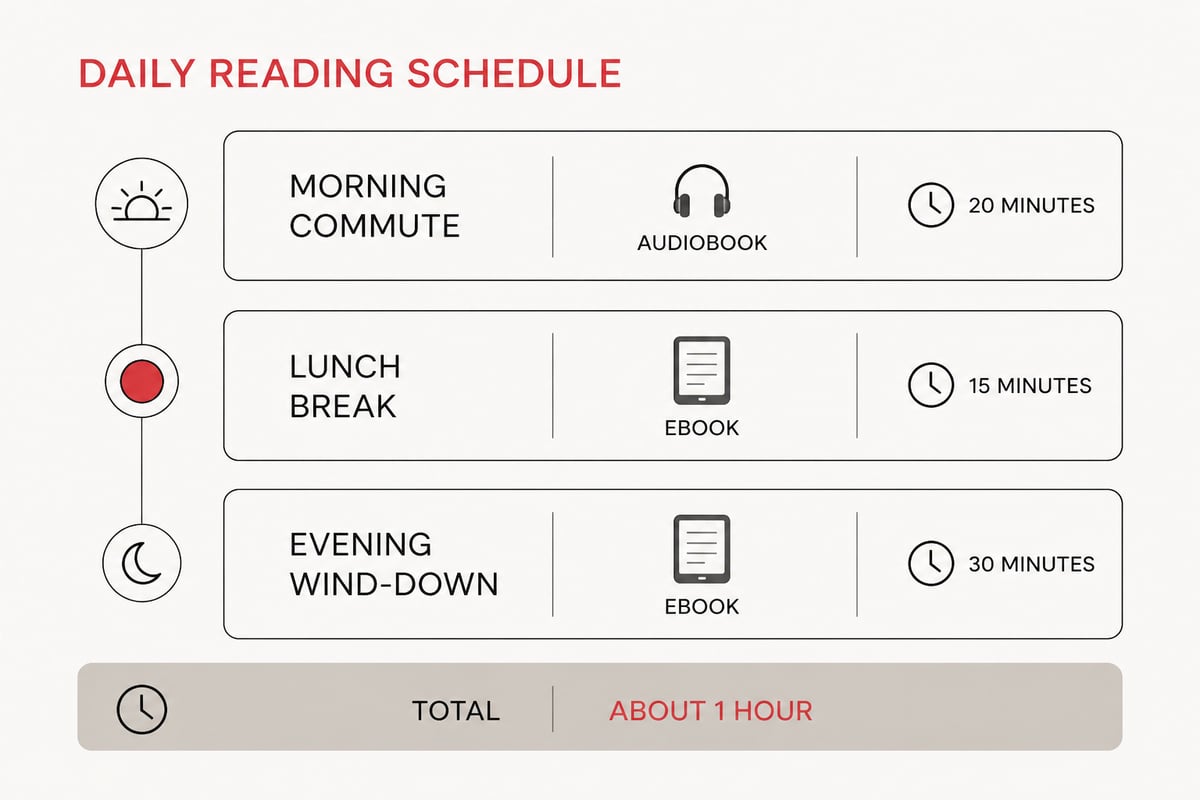
Try this sequence for the first two weeks:
- Pick one anchor moment, such as your morning coffee or your train ride.
- Set a minimum of ten minutes. Stopping early is allowed; skipping is not.
- Keep the book open on your phone's home screen so it is the first thing you see.
- Track pages or minutes in a simple note, not a complicated app.
- After two weeks, add a second anchor moment.
Ten minutes a day adds up. At an average pace of roughly 250 words per minute, that is around 2,500 words daily, which covers a typical novel in about a month before you add a second session. Two or three short sessions bring it closer to a book a week for shorter titles.
Evening reading has a side benefit. The Sleep Foundation notes that reading before bed may help some people relax and fall asleep more easily, and that it can replace screen time whose light may disrupt sleep. A bedtime session can therefore serve two goals at once.
Should You Switch Between eBooks and Audiobooks?
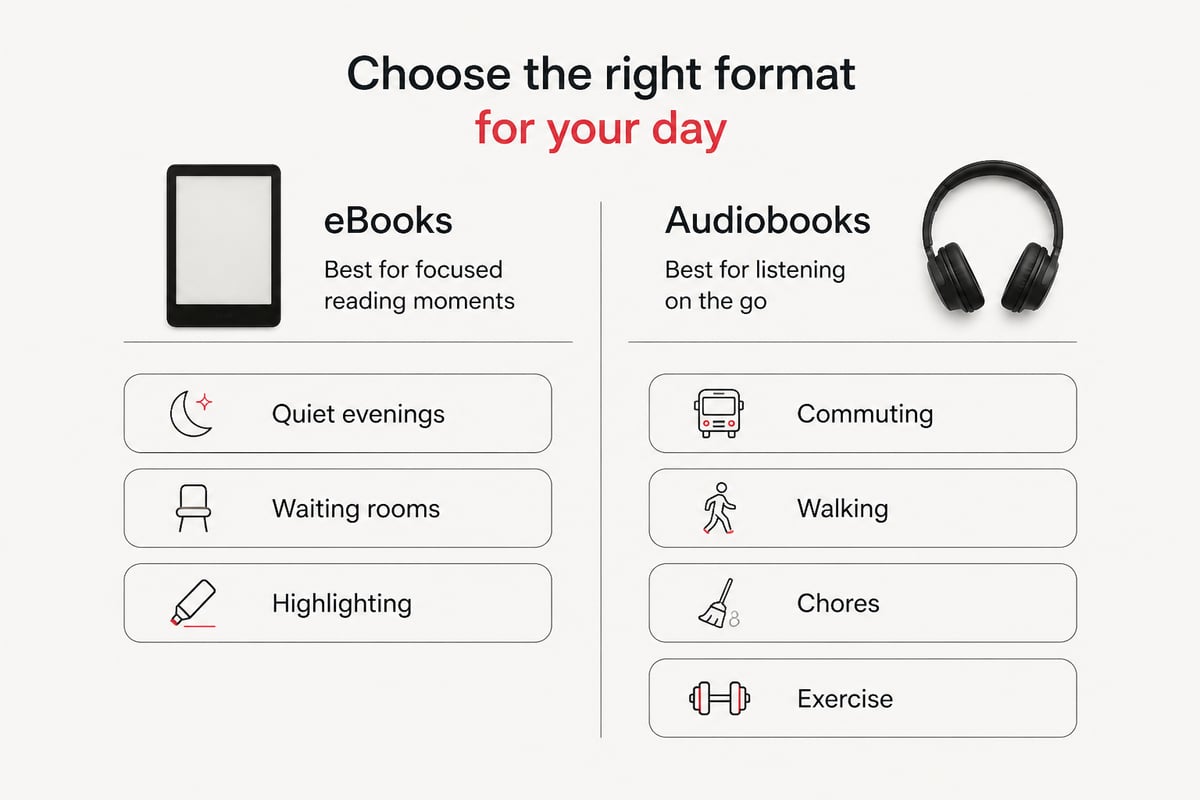
Yes, using both formats lets you read more books because each one fits moments the other cannot. Audiobooks cover hands-busy time, such as walking, cooking or driving. eBooks cover quiet time when you can focus on the screen.
Format habits vary widely. In the 2025 Pew survey, 64% of U.S. adults had read a print book, 31% an e-book, and 26% had listened to an audiobook in the previous 12 months. Many readers use more than one format, and digital formats carry real practical advantages: nothing to pack, adjustable type, and a whole shelf in your pocket.
A useful pairing approach:
- Audiobook for the commute or chores, ideally a narrative title that rewards continuity.
- eBook for evenings, where you control the pace and can highlight passages.
- The same book in both, if you own both versions, so you can switch based on your situation.
For listening ideas, browse the best audiobooks of 2026 to find narrators and genres that hold attention during a long drive.
How Do You Keep Your Library Stocked Without Overspending?
Keep a running list of titles and buy digital copies at discounted prices so cost never becomes the reason you stall. A reader who finishes twenty books a year can spend a surprising amount at full retail, and a high price can make a reader hesitate to take a chance on an unfamiliar author.
Digital ownership also removes logistics. Tell eBook delivers every title as an instant download with no shipping fees or waiting, in the open EPUB format, so books work on Kobo, Nook, phones and tablets. You buy once and keep your books forever, which suits readers who want a permanent library they can read or listen to anywhere.
If budget is the main concern, the Discount eBooks collection offers bestselling eBooks at lower prices than major retailers, with instant EPUB or PDF download. Pair a wish list with the occasional purchase when a title you have been waiting for appears at a lower price.
A few ways to stretch a reading budget further:
- Maintain a wish list and buy only when you are ready to start the book.
- Mix new releases with older titles that cost less but read just as well.
- Try a series, since finishing book one makes book two an easy decision.
- Explore genres through curated pages, such as contemporary love story books or paranormal love story books, before committing to a long series.
How Do You Choose Books You Will Actually Finish?
Choose books that match your current energy and interest, not your idea of what you should be reading. A stalled "important" book is worse for your reading total than a quick, enjoyable one.
Use these guidelines when selecting your next title:
- Match the book to the moment. A dense biography suits a long weekend; a fast thriller suits a busy week.
- Read the first chapter before committing. Most digital stores offer samples, and a first chapter reveals voice and pace.
- Rotate genres. After a heavy nonfiction title, reach for something light.
- Give yourself a drop rule. If you are not engaged by about 50 pages, move on without guilt.
Series are especially efficient for building momentum. A complete set removes the decision fatigue that comes between books. Collections like Frank Herbert’s Dune saga, books 1 to 6 give you six volumes of continuous world, which can carry you through months of reading without a single "what next?" pause.
Shorter nonfiction works well for short windows. A title such as More Than a Hobby by David Green fits the reader who wants practical business reading in focused sessions rather than long marathons.
If you are unsure where to begin, the find your books page can help narrow a direction by category.
What Habits Help You Read More Books Over the Long Term?
Consistency matters more than intensity, so the best habits are small, visible and easy to repeat. The goal is to make reading the default response to a spare moment instead of scrolling.
Habits worth building:
- Charge your device where you read. A dead battery is a common excuse.
- Put your phone in another room during sessions. Given the distraction data above, this single change often delivers the largest gain.
- Read two or three books at once. One fiction, one nonfiction, one audiobook gives you options for every mood.
- Set a yearly count, not a daily page quota. A target such as 24 books gives you flexibility and a clear finish line.
- Keep notes short. One sentence about each book helps you remember what you read and what to pick next.
- Protect one longer session each week. A Sunday morning hour builds momentum for the shorter sessions during the week.
Social accountability can also help. A friend who reads along with you, even informally, is a real advantage. Agree on a title, set a date to compare notes, and let the deadline do some of the work.
Reading also sits within a broader set of personal routines. Readers who invest in their health and recovery tend to find it easier to keep other habits going, whether that means a cycling routine with quality gear from CCN Sport or a structured wellness plan. The common thread is repetition: small actions, scheduled and protected.
FAQ
Are more books being sold now?
Reading remains widespread, and digital formats hold a steady share. Pew's 2025 survey found that 31% of U.S. adults read an e-book and 26% listened to an audiobook in the previous 12 months, so digital and audio formats are a meaningful part of how people read. Sales figures vary by year and by source, so check recent publisher and industry reports for current numbers.
How many books should I aim to read in a year?
Choose a target slightly above your current pace. If you read about five books a year, aiming for eight to ten is realistic; if you already read ten or more, you can set a goal of fifteen to twenty. Pew's data shows that 14% of U.S. adults read more than 20 books a year, so that level is achievable but not typical.
Is it better to read before bed or in the morning?
The best time is whichever you will repeat daily. Evening reading may help you wind down, as the Sleep Foundation notes, while morning reading gives you a session before the day's demands crowd it out. Many readers use both, with a short morning session and a longer one at night.