

The audiobook market has experienced remarkable growth over the past decade, transforming how readers consume literature and how authors reach their audiences. Whether you’re an independent author ready to narrate your own work or a publisher expanding your catalog, understanding the complete process of creating and distributing my audiobook is essential for success in 2026’s competitive digital landscape. The Audio Publishers Association’s 2024 survey confirms that audiobook sales continue to climb year over year, with revenue reaching new heights as consumers embrace audio formats for their convenience and accessibility.
Understanding the Modern Audiobook Landscape
The audiobook industry has evolved from a niche market into a mainstream revenue stream for publishers and authors alike. According to Publishers Weekly, audiobook sales rose 13% in 2024 to $2.2 billion, demonstrating sustained consumer interest in spoken-word content. This growth reflects changing consumption habits as listeners integrate audiobooks into their commutes, workouts, and daily routines.
Key market drivers include:
- Smartphone ubiquity enabling listening anywhere
- Subscription platforms reducing per-title costs
- Improved narration quality and production values
- Expanded genre availability beyond traditional categories
- Integration with smart home devices and automotive systems
The demographic profile of audiobook listeners continues to broaden. Research from Pew Research Center shows that while print books remain popular, digital audio formats are gaining significant traction among younger demographics and busy professionals who value multitasking capabilities.
Market Positioning for Your Title
Before producing my audiobook, strategic positioning determines its potential success. Analyze comparable titles in your genre, study their narration styles, pricing strategies, and listener reviews. Understanding where your audiobook fits within the broader market landscape helps inform critical production decisions.
Consider these positioning factors:
- Genre conventions – Romance listeners expect different narration pacing than thriller audiences
- Length expectations – Business titles often run 6-8 hours while epic fantasy may exceed 20 hours
- Narrator gender and style – First-person narratives typically match narrator gender to protagonist
- Production quality benchmarks – Professional-grade audio is now the minimum standard across platforms

Pre-Production Planning and Preparation
Successful audiobook creation begins long before anyone steps into a recording booth. The pre-production phase establishes the foundation for quality output and efficient production workflows.
Script Preparation and Formatting
Transform your manuscript into a narrator-friendly script. This involves more than simply printing your book. Professional narrators benefit from properly formatted scripts that anticipate potential pronunciation challenges and narrative complexity.
| Script Element | Best Practice | Purpose |
|---|---|---|
| Pronunciation guide | Include phonetic spellings for character names, locations, technical terms | Ensures consistency across sessions |
| Character list | Document each character with brief description and vocal direction | Helps narrator differentiate voices |
| Chapter markers | Clear breaks with timing estimates | Aids in session planning and file organization |
| Foreign phrases | Provide translations and pronunciation notes | Prevents errors and reshoots |
Narrator Selection Strategy
Choosing the right voice for my audiobook significantly impacts listener engagement and sales performance. The narrator becomes the voice readers associate with your work, making this decision critical to long-term success.
Professional narrator considerations:
- Genre expertise – Narrators often specialize in specific categories with established fan bases
- Demo quality – Request samples reading your actual manuscript, not generic demos
- Turnaround time – Professional schedules may require booking months in advance
- Rate structure – Industry standard is $200-400 per finished hour for experienced narrators
- Royalty share options – Some narrators work on revenue-share agreements instead of upfront fees
Self-narration offers complete creative control and eliminates narrator costs, though it demands significant time investment and technical skill. Authors with distinctive voices or established personal brands may find self-narration enhances authenticity, particularly for memoir, business, and self-help titles.
Recording and Production Techniques
The technical quality of my audiobook directly affects listener satisfaction and platform acceptance. Major distributors enforce strict audio specifications that require proper equipment and recording environments.
Studio Setup and Equipment
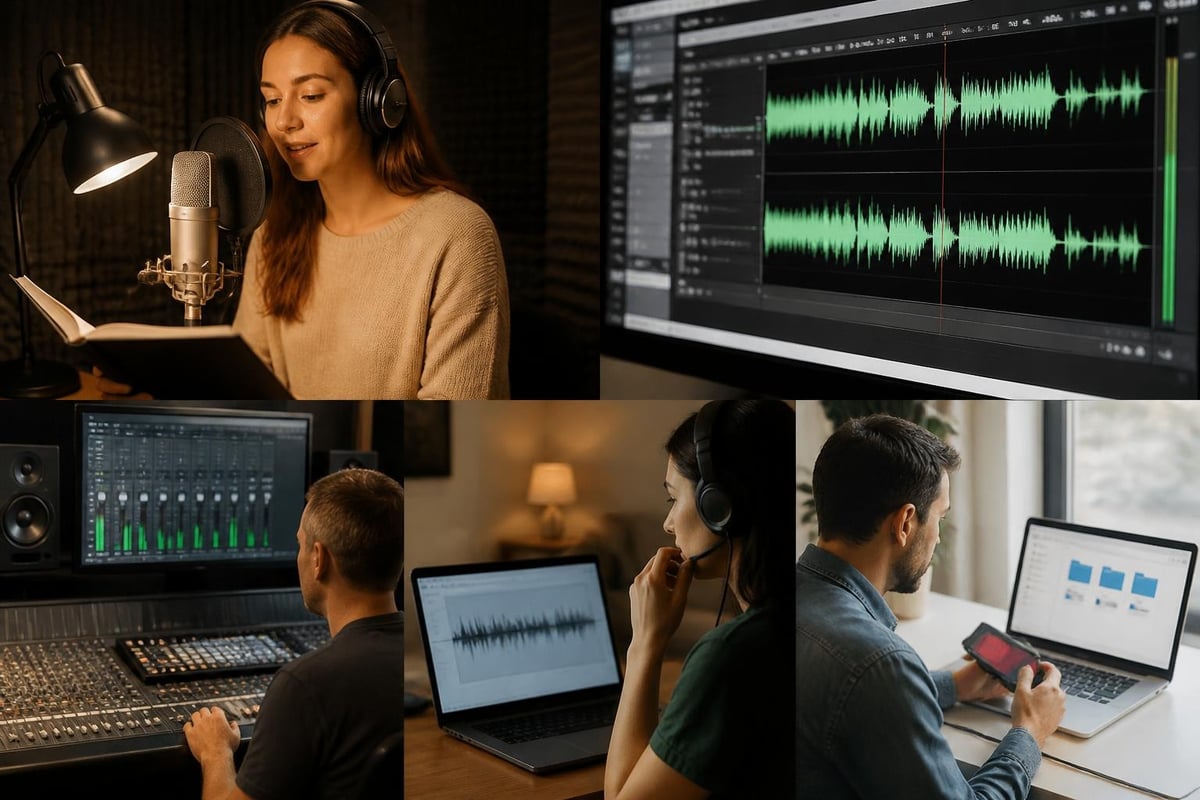
Home recording has become increasingly viable with affordable professional equipment. A basic professional-quality setup includes a large-diaphragm condenser microphone, audio interface, pop filter, and digital audio workstation software. Sound On Sound provides extensive guidance on configuring home studios optimized for spoken-word recording.
Room acoustics matter enormously. Sound treatment with absorption panels, bass traps, and diffusers eliminates echoes and unwanted reflections that degrade audio quality. Many narrators convert closets into makeshift vocal booths, using hanging clothes as natural sound dampening.
Recording best practices:
- Maintain consistent microphone distance (6-8 inches typical)
- Monitor levels to prevent clipping while maximizing signal
- Record in long takes with minimal stops to maintain vocal consistency
- Hydrate frequently but avoid mouth sounds by proper mic technique
- Save multiple backup copies to separate drives during sessions
Advanced Audio Processing
Post-production transforms raw recordings into polished, professional audiobooks. This phase involves editing out mistakes, normalizing volume levels, removing unwanted sounds, and applying subtle processing to enhance clarity.
Professional editing requires specialized skills and software. Many narrators outsource editing to dedicated audio engineers who understand the nuanced requirements of long-form spoken content. Standard processing includes noise reduction, de-essing to control sibilance, compression for consistent dynamics, and EQ to optimize vocal presence.
The recent research on expressive speech synthesis demonstrates how AI-assisted tools are beginning to support certain production tasks, though human narration remains the gold standard for emotional nuance and interpretive performance. Cutting-edge text-aware synthesis approaches show promise for accessibility applications but cannot yet match professional narrators for commercial audiobooks.
Distribution Platforms and Strategies
Selecting the right distribution channels for my audiobook determines market reach and revenue potential. Each platform offers distinct advantages, audience demographics, and terms that require careful evaluation.
Major Platform Comparison
| Platform | Market Share | Royalty Rate | Exclusivity | Best For |
|---|---|---|---|---|
| Audible (ACX) | ~60-65% | 40% (exclusive) / 25% (non-exclusive) | Optional | Maximum reach |
| Apple Books | ~10-15% | 70% | Non-exclusive | iOS users |
| Google Play | ~5-8% | 70% | Non-exclusive | Android users |
| Kobo Audiobooks | ~3-5% | 70% | Non-exclusive | International markets |
| Findaway Voices | Aggregator | Variable | Non-exclusive | Wide distribution |
Audible dominates the audiobook market through aggressive marketing and the popular subscription model. However, exclusivity requirements mean you cannot distribute my audiobook through competing platforms if you select ACX’s higher royalty tier. Non-exclusive distribution maximizes availability but reduces per-unit revenue from Audible sales.
Pricing Strategy and Positioning
Audiobook pricing follows different logic than ebook pricing. Consumers evaluate value based on listening hours rather than page count, with expectations shaped by subscription services offering unlimited access for fixed monthly fees.
Standard pricing tiers in 2026:
- Under 5 hours: $9.99 – $14.99
- 5-10 hours: $14.99 – $19.99
- 10-15 hours: $19.99 – $24.99
- Over 15 hours: $24.99 – $34.99
Subscription credits complicate pricing dynamics. Most Audible members purchase using monthly credits rather than cash, making every title effectively equal-priced from the consumer perspective. This reality shifts competitive advantage toward marketing, reviews, and metadata optimization rather than pure price competition.
Readers looking for value might explore discount audiobooks offering instant downloads at competitive prices across multiple genres. For listeners who enjoy both formats, combining audiobook listening during commutes with ebook reading at home creates a complementary consumption pattern.
Technical Specifications and Quality Control
Meeting platform technical requirements prevents rejection and ensures optimal listener experience. Distributors maintain strict standards for audio quality, file formatting, and metadata completeness.
Audio Quality Standards
ACX and most major platforms require:
- Constant bit rate MP3 files at 192 kbps or higher
- Mono or stereo (mono preferred for spoken word)
- 44.1 kHz sample rate
- Peak levels between -23dB and -18dB RMS
- Maximum -3dB peak levels
- Noise floor below -60dB
Room tone sections bookend each file to facilitate seamless playback transitions. Opening credits include title, author, and narrator information. Closing credits provide publication details and copyright notices. U.S. Copyright Office guidance clarifies registration requirements for audiobook sound recordings, establishing legal protection for your work.
Quality control involves detailed listening passes checking for audio artifacts, mispronunciations, skipped words, background noise, and consistency issues. Professional proofreaders follow along with the manuscript, marking every deviation for correction. This labor-intensive process typically requires 2-3 hours of review per finished hour.
Marketing and Audience Development
Creating exceptional audio content represents only half the success equation. Effective marketing determines whether my audiobook finds its intended audience and generates sustainable sales.
Launch Strategy Components
Coordinate your audiobook release with complementary marketing activities across multiple channels. A successful launch typically spans 4-6 weeks of concentrated effort building anticipation and momentum.
Pre-launch activities (3-4 weeks before release):
- Announce production on author website and email list
- Share behind-the-scenes content from recording sessions
- Release sample chapters through SoundCloud or YouTube
- Coordinate with book bloggers and podcast hosts for early reviews
- Prepare promotional graphics optimized for social platforms
Launch week tactics:
- Email announcements to your complete subscriber list
- Social media campaign with narrator interviews and clips
- Promotional pricing for first week (if platform allows)
- Request reviews from advance listeners and influencers
- Cross-promote on relevant podcasts and audiobook communities
Leveraging Reviews and Social Proof
Reviews drive audiobook discovery more than almost any other factor. Platforms feature highly-rated titles in recommendation algorithms, making early positive reviews critical for long-term visibility.
Ethical review generation focuses on reaching genuine listeners most likely to enjoy your specific title. Target readers of similar books in your genre through genre-specific Facebook groups, Goodreads communities, and niche book clubs. Offer review copies through NetGalley or directly to established book bloggers with relevant audiences.
Narrator recognition matters significantly in audiobook marketing. Titles narrated by award-winning performers benefit from established fan bases who follow narrators across multiple books. If you’ve selected a narrator with a following, coordinate with them on cross-promotional opportunities that benefit both parties.

Rights Management and Legal Considerations
Protecting your intellectual property while properly licensing necessary rights requires understanding the legal framework governing audiobook production and distribution.
Copyright and Licensing Fundamentals
The audiobook represents a derivative work of the underlying text. If you wrote the original book, you hold necessary rights to create the audiobook. However, if you’re producing someone else’s work, secure explicit audio rights through your publishing contract or separate licensing agreement.
Narrator agreements should clearly specify:
- Work-for-hire status or performance rights ownership
- Usage limitations and exclusivity terms
- Credit requirements and promotional usage
- Revision and correction obligations
- Payment terms and royalty calculations (if applicable)
Music and sound effects require separate licensing unless specifically created as work-for-hire for your project. Many audiobooks avoid music entirely to eliminate licensing complexity and costs. When sound design enhances the narrative, use royalty-free libraries or commission original compositions with clear usage rights.
International Distribution Rights
Global distribution requires attention to territorial rights. Your publishing contract may limit distribution to specific countries or language markets. Verify you have worldwide rights before distributing through international platforms.
Translation presents additional considerations. If producing my audiobook in languages beyond the original publication, ensure you hold translation rights or license them from the appropriate rights holder. Each language version requires separate narrator agreements, production workflows, and platform submissions.
Advanced Production Techniques
Professional audiobook production increasingly incorporates sophisticated techniques that enhance listener engagement and production efficiency.
Immersive Audio and Spatial Sound
Emerging technologies like Dolby Atmos for audiobooks and podcasts enable spatial audio experiences that place listeners within three-dimensional soundscapes. While still niche in 2026, immersive audio offers differentiation opportunities for premium productions, particularly in genres like thriller, science fiction, and fantasy where atmospheric sound design enhances storytelling.
Implementation requires specialized mixing tools and platform support. Apple Books and select premium platforms support spatial audio playback, though standard stereo remains compatible with all devices and platforms. Evaluate whether the additional production investment aligns with your target audience and marketing positioning.
Multi-Narrator Productions
Complex narratives benefit from multiple narrators representing different character perspectives or timeframes. Multi-narrator productions require careful coordination, consistent direction, and additional editing complexity.
Multi-narrator considerations:
- Budget increases proportionally with additional performers
- Editing complexity multiplies with voice transitions
- Character continuity demands detailed production notes
- Listener preferences vary (some prefer single-narrator consistency)
- Marketing highlights ensemble cast as premium feature
Performance Metrics and Optimization
Understanding how my audiobook performs across platforms informs marketing adjustments and future production decisions.
Key Performance Indicators
Track these metrics monthly to identify trends and opportunities:
- Sales velocity – Units sold per week/month
- Conversion rate – Sample listens to purchases
- Completion rate – Percentage of listeners finishing the full book
- Review quantity and average rating – Social proof indicators
- Return rate – Quality and expectation-match signal
- Subscription credit usage – Audible member selection patterns
Platform analytics vary widely. Audible provides detailed sales reporting while other platforms offer minimal data. Aggregate information across channels using spreadsheet tracking or dedicated author business tools.
Iterative Improvement Strategies
Use performance data to refine marketing messages and targeting. If completion rates lag, investigate whether length, pacing, or narrator style may be factors. Low conversion from samples suggests metadata optimization opportunities or potential sample chapter replacement.
A/B test different marketing approaches using platform advertising tools. Amazon/Audible ads allow testing various book descriptions, targeting parameters, and promotional angles. Small budget experiments reveal which messages resonate before committing to larger campaigns.
For readers who appreciate both formats, Tell eBook offers an extensive selection across fiction and literature, business and finance, and biography and memoir categories. Many readers discover they enjoy combining audiobook listening with traditional ebook reading depending on context and activity.
Platform-Specific Optimization Strategies
Each distribution platform rewards different optimization approaches. Tailoring metadata, marketing, and pricing to platform-specific algorithms maximizes visibility.
Audible/ACX Optimization
Audible’s recommendation engine weighs multiple signals including sales velocity, review ratings, listen-through rates, and wishlist additions. Optimize these factors through:
Metadata refinement:
- Accurate primary and secondary category selection
- Comprehensive keyword research for search discovery
- Compelling book description using benefit-focused language
- Professional cover design sized for thumbnail recognition
Promotional tactics:
- WhisperSync for Voice compatibility with Kindle edition
- Enrollment in Audible Plus catalog (if offered)
- Strategic use of promotional codes for reviews
- Author profile completeness with links to website and social media
Alternative Platform Strategies
Non-Audible platforms offer opportunities for authors seeking broader distribution. Apple Books reaches iOS-centric audiences with high engagement rates. Google Play captures Android users globally. Smaller platforms like Kobo serve international markets underserved by Audible.
Distribution aggregators like Findaway Voices and Authors Direct simplify multi-platform management by handling encoding, delivery, and royalty collection across dozens of retailers simultaneously. This approach trades individual platform optimization for broad availability and administrative simplicity.
Building Long-Term Audiobook Success
Sustainable audiobook revenue requires viewing my audiobook as one component within a broader author business strategy rather than a one-time product launch.
Series and Backlist Leverage
Audiobook listeners exhibit strong series loyalty. Once engaged with a compelling narrator and story, they eagerly consume subsequent installments. Prioritize series audiobook production over standalone titles when possible, as each new release drives discovery and sales of earlier books.
Backlist audiobook conversion presents significant opportunity. Older titles with proven sales records and existing reader bases minimize production risk. The Association of American Publishers reports that digital formats, including audiobooks, continue growing as percentages of overall publishing revenue, making backlist conversion increasingly profitable.
Narrator Partnerships and Consistency
Establishing ongoing relationships with talented narrators creates consistency that readers value. When listeners love a narrator’s interpretation of your work, they anticipate that same voice for future titles. This expectation builds brand loyalty and reduces listener hesitation when new books release.
Long-term narrator partnerships also streamline production. Familiar narrators require less direction, understand your characters and world-building intuitively, and work more efficiently on subsequent projects. Consider revenue-share arrangements that align incentives and reduce upfront costs while building collaborative relationships.
Cross-Format Marketing Synergies
Coordinate audiobook marketing with ebook and print campaigns for maximum efficiency. Readers who discover your work in one format often consume others. Bundle pricing, cross-format promotions, and synchronized release dates create multiple entry points for different reader preferences.
Email marketing becomes particularly effective when segmenting subscribers by format preference. Audiobook-exclusive promotions reach listeners directly while avoiding irrelevant messages to readers who prefer text formats. Behavioral data from previous purchases enables increasingly sophisticated targeting over time.
Many savvy readers combine formats strategically. They might explore new authors through affordable mystery ebook deals before committing to longer audiobook purchases, or discover titles through fantasy ebook promotions that they later re-experience as audiobooks during commutes.
Creating and distributing my audiobook successfully requires balancing artistic vision with technical expertise, marketing savvy, and business acumen. The audiobook market’s continued growth provides opportunities for authors willing to invest in quality production and strategic distribution across multiple platforms. Whether you’re launching your first audiobook or expanding an established catalog, understanding the complete production pipeline from pre-production through marketing optimization positions your work for maximum impact and sustainable revenue. Tell eBook supports readers and listeners across formats with diverse selections spanning fiction, nonfiction, and specialized genres, helping audiences discover their next favorite story in whatever format suits their lifestyle.