

Understanding the relationship between EPUB and Kindle formats is essential for anyone involved in digital publishing, whether you’re running an online bookstore, self-publishing, or simply managing a personal ebook library. The epub kindle compatibility question arises frequently because EPUB represents the industry-standard open format, while Kindle uses Amazon’s proprietary format. This fundamental difference creates both challenges and opportunities for publishers and readers navigating the 2026 digital reading landscape.
The Technical Foundation of EPUB and Kindle Formats
EPUB has evolved significantly since its inception, with the W3C’s official EPUB 3.3 Recommendation now serving as the authoritative standard for digital publishing. This format provides a flexible, HTML-based structure that works across multiple reading platforms and devices. Converting between these open standards and Amazon’s ecosystem requires understanding how they translate into each other.
EPUB Format Architecture
EPUB files are essentially packaged websites, consisting of XHTML documents, CSS stylesheets, images, and metadata bundled into a single container. The format supports:
- Reflowable text that adapts to different screen sizes
- Fixed-layout options for illustrated books and comics
- Rich media integration including audio and video
- Accessibility features for assistive technologies
- Interactive elements through JavaScript support
The modular nature of EPUB makes it ideal for distributing content across various platforms, which is why most publishers create EPUB versions first before converting to other formats.
Kindle Format Evolution
Amazon’s Kindle format has undergone multiple iterations, moving from the original MOBI through KF8 to the current KPF format. Modern Kindle devices and apps now accept EPUB files directly through Kindle Direct Publishing, though Amazon converts them internally to optimized Kindle formats.
The compatibility landscape changed dramatically in 2026 as Amazon expanded EPUB support, recognizing the format’s dominance in the publishing industry.

Converting Between EPUB and Kindle Formats
The conversion process between these two formats requires attention to detail and proper tooling to maintain formatting, metadata, and accessibility features. Publishers and ebook stores like Tell eBook must understand these workflows to deliver quality content across platforms.
Professional Conversion Tools
| Tool | Primary Use | Key Features | Cost |
|---|---|---|---|
| Calibre | General conversion | Batch processing, metadata editing, library management | Free |
| Kindle Previewer | Amazon validation | Official KDP testing, device emulation | Free |
| EPUBCheck | Validation | EPUB 3.3 conformance checking | Free |
| Vellum | Professional publishing | Template-based design, multi-format export | Paid |
Calibre’s comprehensive documentation provides extensive guidance for managing conversion workflows. The software handles bulk operations efficiently, making it invaluable for online bookstores managing large catalogs.
Step-by-Step Conversion Process
- Validate your source EPUB using the EPUBCheck project on GitHub to identify structural issues
- Review metadata ensuring title, author, ISBN, and description fields are complete and accurate
- Test formatting in multiple reading environments to catch display issues
- Convert using your chosen tool, applying appropriate settings for target devices
- Preview the Kindle version using KDP’s Kindle Previewer tool
- Validate accessibility features remain intact after conversion
- Upload to distribution platforms following each platform’s specific requirements
Conversion quality depends heavily on the source file’s structure. Well-formed EPUB files with semantic HTML and proper CSS cascade smoothly into Kindle formats, while poorly constructed files may require manual remediation.
Common Conversion Challenges
Font embedding presents frequent issues during conversion. While EPUB supports custom fonts through CSS @font-face rules, Kindle has specific requirements for font licensing and file size optimization. Publishers must verify that font licenses permit ebook distribution and that file sizes remain manageable.
Table formatting often breaks during conversion because Kindle’s older rendering engines handle complex CSS differently than modern web browsers. Simplifying table structures and using inline styles can improve cross-platform consistency.
Image optimization becomes critical when converting illustrated content. EPUB allows various image formats, but Kindle performs best with properly sized JPEG files. Oversized images bloat file sizes and slow device performance.
Publishing Standards and Best Practices
The Book Industry Study Group metadata resources provide essential guidance for digital publishing workflows. Proper metadata ensures discoverability across retail platforms and library systems.
Metadata Requirements
Complete, accurate metadata forms the foundation of successful digital publishing. For both formats, focus on:
- ONIX records for retail distribution channels
- Dublin Core elements embedded in EPUB files
- Amazon-specific fields including BISAC codes and keyword optimization
- Accessibility metadata describing available features
- Series information for multi-volume works
Online platforms like those found in Tell eBook’s extensive categories demonstrate how proper categorization and metadata improve reader discovery.

Accessibility Considerations
The DAISY Consortium’s Accessible Publishing Knowledge Base offers authoritative guidance for creating accessible digital publications. Accessibility isn’t just ethical-it’s increasingly required by law in many jurisdictions.
Key accessibility features include:
- Semantic HTML5 structure with proper heading hierarchy
- Alternative text for all meaningful images
- Logical reading order independent of visual presentation
- Table of contents with proper navigation
- Support for text-to-speech and screen readers
Testing converted files through epubtest.org reveals how different reading systems handle accessibility features. This testing helps identify platform-specific issues before publication.
Organizations seeking third-party validation can pursue Benetech’s Global Certified Accessible program, which certifies EPUB publications meet rigorous accessibility standards. While certification adds cost, it demonstrates commitment to inclusive publishing.
Platform-Specific Optimization Strategies
Different retail platforms and reading applications handle these formats with varying capabilities. Understanding these differences enables publishers to optimize content for each environment.
Amazon Kindle Optimization
Amazon’s file processing includes automatic conversion and enhancement. Publishers can leverage these features by:
Enabling Enhanced Typesetting, which activates advanced formatting features including kerning, ligatures, and improved hyphenation. This feature requires properly structured EPUB source files with semantic markup.
Optimizing cover images to Amazon’s specifications: 2560 x 1600 pixels minimum, with 1:1.6 ratio preferred. High-quality covers significantly impact sales conversion rates.
Structuring series metadata properly helps readers discover related titles. The Tell eBook series catalog demonstrates effective series organization.
Multi-Platform Distribution
Publishers distributing through multiple channels must balance platform-specific optimizations with maintaining a single master file. The conversion workflow typically involves:
| Stage | Action | Platform |
|---|---|---|
| Master creation | Build validated EPUB 3.3 | All platforms |
| Amazon upload | Direct EPUB to KDP | Kindle |
| Retail distribution | EPUB to aggregators | Apple Books, Kobo, Nook |
| Library sales | EPUB with library DRM | OverDrive, Hoopla |
| Direct sales | EPUB with or without DRM | Publisher website |
This approach maintains content quality while serving diverse distribution channels efficiently.
Format Selection for Different Content Types
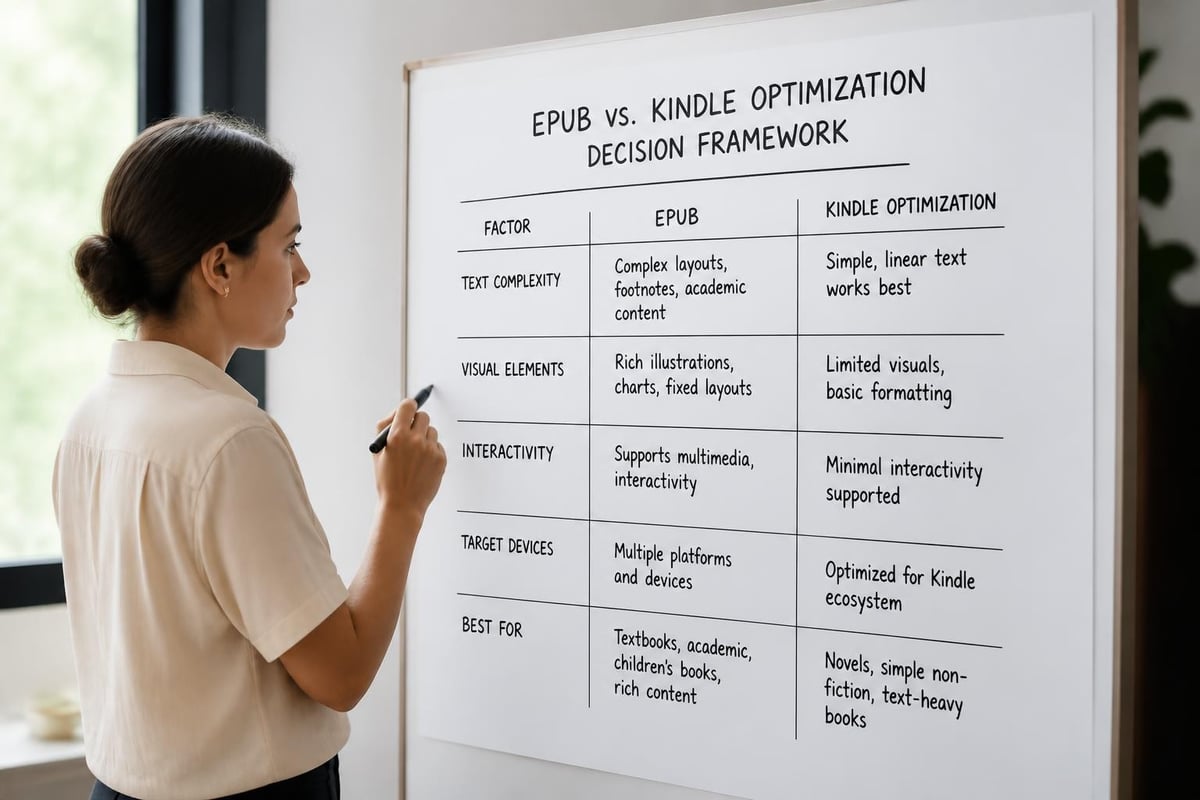
Choosing between these formats-or determining conversion priorities-depends heavily on content characteristics. Different book categories require different approaches.
Fiction and Narrative Content
Text-heavy fiction converts seamlessly between the two formats with minimal intervention. These books benefit from:
- Reflowable layouts that adapt to user preferences
- Simple CSS for consistent typography
- Minimal embedded media
- Straightforward table of contents
Romance novels, thrillers, and literary fiction from Tell eBook’s fiction collection exemplify content that works well across all platforms with standard conversion workflows.
Non-Fiction and Educational Materials
Complex non-fiction requires careful attention during conversion:
- Business books with charts and diagrams need tested layouts (business category examples)
- Technical manuals may require fixed-layout EPUB to preserve precise formatting
- Cookbooks benefit from landscape orientation options and high-quality food photography
- Academic texts need robust footnote and citation handling
The Tell eBook cooking collection showcases how recipe books balance visual appeal with practical functionality across devices.
Visual and Interactive Content
Comics, graphic novels, and illustrated books present unique conversion challenges:
Fixed-layout EPUB provides precise control over page design, essential for panel-by-panel comic reading experiences found in Tell eBook’s comics section. However, fixed-layout files:
- Require separate layouts for portrait and landscape orientations
- Don’t support dynamic text resizing
- Create larger file sizes
- May not work optimally on all devices
The format decision for visual content often involves creating multiple versions: fixed-layout for tablets and computers, and carefully reformatted reflowable editions for smaller screens.
Children’s Books
Children’s illustrated books combine text and images in ways that complicate format conversion:
- Picture books typically use fixed-layout EPUB
- Early readers need large, clear fonts with careful image placement
- Chapter books for older children work well with standard reflowable formats
- Interactive elements may not survive conversion to Kindle
Publishers in Tell eBook’s creative kids category must test extensively across devices to ensure young readers have positive experiences.
Quality Assurance and Testing Protocols
Rigorous testing prevents the formatting disasters that plague poorly converted files. Professional publishers implement systematic quality checks before release.
Pre-Conversion Validation
Before beginning conversion, validate source files using:
- EPUBCheck for structural conformance
- Manual inspection of file contents using EPUB editors
- Reading system tests across representative devices
- Accessibility evaluations using screen readers
This upfront investment identifies issues while they’re easiest to fix. Correcting problems in source EPUB files improves outcomes across all output formats.
Post-Conversion Testing Matrix
After conversion, test across multiple dimensions:
| Device Type | Screen Size | Operating System | Reading App |
|---|---|---|---|
| Kindle Paperwhite | 6" e-ink | Proprietary | Native |
| iPad | 10" tablet | iOS | Kindle app |
| Android phone | 6" smartphone | Android | Kindle app |
| Windows PC | Desktop | Windows | Kindle app |
This matrix ensures conversions work across the devices readers actually use. Focus testing on the devices your audience prefers based on analytics data.
Automated Testing Workflows
Large-scale digital publishing operations benefit from automated testing tools that batch-process files and flag potential issues. These systems:
- Validate EPUB structure against current specifications
- Check image sizes and formats for optimization opportunities
- Verify metadata completeness across required fields
- Test hyperlinks to ensure navigation functions properly
- Generate preview screenshots for visual comparison
Automation scales quality assurance efforts, allowing publishers to maintain high standards across thousands of titles.
Distribution and Retail Considerations
The digital publishing ecosystem extends beyond technical formats into business relationships, pricing strategies, and reader expectations. Understanding distribution dynamics helps publishers maximize reach and revenue.
Direct Publishing Platforms
Kindle Direct Publishing dominates self-publishing and independent press distribution. The platform’s EPUB acceptance streamlines workflows, allowing publishers to upload EPUB files directly rather than using conversion tools.
Other major platforms including Apple Books, Kobo, and Google Play Books accept EPUB as their primary format. This standardization benefits publishers managing multi-platform distribution.
Aggregator Services
Publishers distributing through aggregators like Draft2Digital, PublishDrive, or IngramSpark upload EPUB files once and reach dozens of retailers. These services handle format conversion automatically, though publishers should still validate final output.
Aggregators typically charge either:
- Percentage of sales revenue (10-15% common)
- Annual subscription fees for unlimited distribution
- Per-title fees for catalog additions
The economics favor aggregators for publishers with extensive backlists seeking wide distribution without managing individual retailer relationships.
Pricing and DRM Strategy
The format choice doesn’t dictate pricing, but different platforms enforce different price floors and royalty structures. Amazon’s KDP Select program, for example, requires exclusivity but offers promotional tools and higher royalty rates.
DRM (Digital Rights Management) remains contentious in digital publishing:
- Proponents argue DRM prevents piracy
- Critics note DRM frustrates legitimate customers
- Evidence suggests DRM’s effectiveness is limited
- Some publishers successfully sell DRM-free files
Platforms like Tell eBook must balance publisher preferences, customer expectations, and platform requirements when implementing DRM policies.
Future Developments in EPUB and Kindle Formats
The W3C’s recent work on EPUB 3.3 and Amazon’s evolving Kindle capabilities point toward continued format convergence. Several trends will shape digital publishing in coming years.
Enhanced Reading Features
Modern ebook files increasingly support sophisticated features:
- Adjustable layouts that respond to user preferences
- Embedded fonts from expanded typography libraries
- Audio synchronization for read-along experiences
- Interactive quizzes and exercises for educational content
- Social sharing of highlights and annotations
These capabilities blur the line between ebooks and applications, creating richer reading experiences while maintaining backward compatibility with older devices.
Accessibility Mandates
Legal requirements for accessible publishing continue expanding globally. The European Accessibility Act and similar legislation require publishers to ensure ebook files work with assistive technologies. This regulatory environment makes accessibility testing and certification increasingly important.
Publishers can view accessibility as a competitive advantage rather than mere compliance. Accessible books serve broader audiences including readers with visual impairments, dyslexia, and learning differences.
Artificial Intelligence Integration
AI tools are transforming ebook production workflows:
- Automated formatting converts raw manuscripts to publication-ready EPUB
- Quality checking identifies formatting inconsistencies automatically
- Metadata generation suggests categories, keywords, and descriptions
- Translation services enable efficient multi-language publishing
- Accessibility remediation adds alternative text and semantic markup
These tools reduce production costs and timelines while improving output quality, particularly beneficial for smaller publishers and self-published authors.
Mastering epub kindle formats, conversion workflows, and publishing standards positions digital publishers for success in 2026’s competitive marketplace. Whether you’re converting backlist titles, launching new releases, or building a comprehensive ebook catalog, attention to format quality and platform optimization delivers better reader experiences and stronger sales performance. Tell eBook offers an extensive collection of professionally formatted ebooks and audiobooks across diverse categories, ensuring readers enjoy properly optimized content on any device they choose.