

Description
The Leonardo of our age — or its lovable crackpot? You Belong to the Universe celebrates R. Buckminster Fuller (1895–1983): inventor of the geodesic dome, prophet of ‘spaceship Earth,’ the man who wanted to redesign everything — housing, cars, money, the whole human project. Visionary or crank? This book makes the case for visionary, and it’s a strong one.
Fuller’s life reads like science fiction: expelled from Harvard twice, contemplating suicide at 32, then reinventing himself as humanity’s design consultant. The domes, the Dymaxion car, the tensegrity structures — and the ideas about sustainability and ‘doing more with less,’ decades ahead of their time and more urgent now than ever.
Inspiring, eccentric, and unexpectedly moving. For inventors, dreamers, and anyone who suspects the world could be designed better. Fuller believed it could — and built the proof. Fuller’s optimism feels radical now: a reminder that imagination is a practical tool. Bracing and unexpectedly moving.
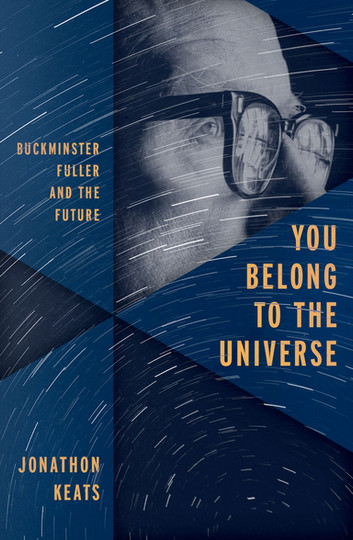
R. Buckminster Fuller (1895–1983) spent six decades trying to make the world work for one hundred percent of humanity — through the geodesic dome, the Dymaxion house and car, and a philosophy of design he called “doing more with less.” In You Belong to the Universe (Oxford University Press, 2016), writer, artist, and experimental philosopher Jonathon Keats argues that Fuller’s strange, sprawling body of thought is not a relic of the 1960s but a toolkit for the present.
n
nAcross 240 pages, Keats traces Fuller’s career from failed businessman to counterculture guru, unpacking the ideas that made him famous: comprehensive anticipatory design, the World Game, the vision of Spaceship Earth as a single system we all crew together. But this is no simple celebration. Keats is a clear-eyed guide, testing Fuller’s claims against today’s realities and asking what genuinely survives as useful method.
n
nThe result is a short, sharp biography of ideas — equal parts life story and manual for creative problem-solving. For designers, engineers, environmental thinkers, and anyone who suspects the future needs bolder thinking, this is an invigorating introduction to one of the twentieth century’s most original minds.





Reviews
There are no reviews yet