

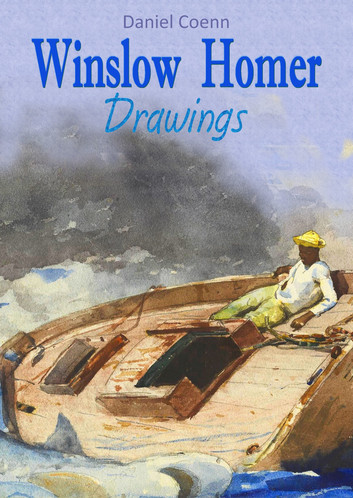
Description
Before the great oils and watercolors, there was the pencil — and Winslow Homer's hand was never idle. Winslow Homer (1836–1910), regarded by many as the greatest American painter of the nineteenth century, drew constantly: on battlefields as a Civil War illustrator, on the Maine coast, in the Adirondacks, and during his winter sojourns in the Bahamas. This collection, compiled by Daniel Coenn, gathers his drawings in one volume — the working foundation of an art built on direct observation. Here are the studies for the marine paintings that made him famous: fishermen and sailors, children at play, hunters in the wilderness, and the dramatic seascapes of Prouts Neck.
Homer drew what he saw, quickly and without fuss, and these sheets carry the same unsentimental power as the finished canvases — sometimes more, for the hand is right there on the page. That immediacy is what makes this volume so valuable. A finished oil can hide its making; a drawing cannot. You will see the quick notations that fixed a wave's shape before it broke, the honest lines that captured a fisherman's stance, and the way Homer tested compositions in miniature before committing to a large work. For anyone learning to draw, these pages are a lesson in economy: how much can be said with how little, and how observation, not decoration, gives a picture its force. They also show his range beyond the sea: children at play, hunters in the wilderness, and quiet inland scenes prove his eye was as sharp on land as on water, and that his honesty as an observer never depended on a dramatic subject.
For students of drawing and lovers of American art, this is a rare look at a master's working method: the quick notations, the honest lines, the thinking of an artist who never painted a wasted stroke. It works beautifully alongside a volume of his paintings, letting you follow an idea from first sketch to finished masterpiece. Get the ebook edition here at a discount from Tellebook.
—


Reviews
There are no reviews yet