Description
The Thoughts of Blaise Pascal: Timeless Wisdom on Faith, Reason, and Human Nature
Introduction to Blaise Pascal’s Thoughts and Their Enduring Relevance
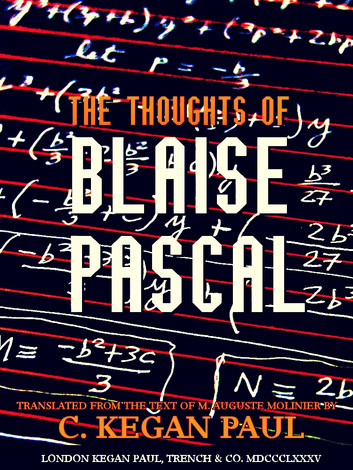
“The Thoughts of Blaise Pascal” presents profound insights from one of history’s greatest minds. These Blaise Pascal thoughts explore faith, reason, mortality, and what it means to be human. Furthermore, this collection reveals a brilliant mathematician grappling with life’s deepest questions.
The work emerged from Pascal’s personal notebooks and unfinished writings after his death. Additionally, editors M. Auguste Molinier and C. Kegan Paul carefully preserved his wisdom. Consequently, readers gain access to Pascal’s most intimate philosophical and spiritual reflections.
Pascal wrote during the 17th century, a time of scientific revolution and religious upheaval. Moreover, his thoughts beautifully bridge the gap between rational inquiry and spiritual devotion. This collection demonstrates that faith and reason need not conflict. Therefore, his ideas remain remarkably relevant to contemporary readers seeking meaning and purpose.
Pascal’s Life and Historical Context
Blaise Pascal lived in France from 1623 to 1662, during a transformative period. He showed extraordinary mathematical talent from childhood, inventing a calculating machine at nineteen. Furthermore, he made groundbreaking contributions to geometry, probability theory, and physics throughout his life. His scientific achievements earned him recognition among Europe’s leading intellectuals and scholars.
However, Pascal experienced a profound religious conversion in 1654 that changed his priorities. Consequently, he devoted his remaining years to theological and philosophical writing instead. He joined the Jansenist movement, a Catholic reform group emphasizing grace and predestination. Moreover, he defended Jansenism against Jesuit critics through his famous “Provincial Letters” publication.
Pascal’s health remained fragile throughout his life, causing him considerable physical suffering regularly. Additionally, he died at only 39, leaving many projects unfinished. His “Thoughts” are fragments intended for a comprehensive defense of Christianity that he never completed. Therefore, the work offers glimpses into a brilliant mind wrestling with ultimate questions.
Core Philosophical Ideas in Blaise Pascal’s Thoughts
Pascal believed that human beings exist in a paradoxical state between greatness and wretchedness. He argued that people possess remarkable reasoning abilities yet remain fundamentally limited and flawed. Furthermore, he observed that humans seek happiness but rarely find lasting satisfaction or peace. This tension defines the human condition and constantly drives our search for meaning.
The philosopher emphasized that reason alone cannot adequately answer life’s most important questions. Consequently, he argued that faith provides knowledge that transcends rational understanding and logic. However, Pascal never dismissed reason as unimportant or irrelevant to human flourishing. Moreover, he believed reason prepares the heart to receive truths beyond its grasp.
Pascal introduced the concept of “diversion” to explain how people avoid confronting existential realities. He observed that humans constantly distract themselves with entertainment, work, and trivial pursuits. Additionally, he argued that this avoidance stems from fear of facing our mortality. Therefore, genuine self-knowledge requires courage to examine our condition honestly and unflinchingly.
Religious and Spiritual Insights
Pascal’s thoughts on Christianity emphasize the necessity of a direct personal encounter with God. He distinguished between the “God of Abraham, Isaac, and Jacob” and the philosophers’ abstract deity. Furthermore, he insisted that true faith involves the heart, not just intellectual assent. His famous phrase “the heart has its reasons which reason knows nothing of” captures this.
The work explores humanity’s fallen nature and our desperate need for divine grace. Additionally, Pascal argued that people cannot save themselves through good works or moral effort. He believed that recognizing our helplessness opens us to receiving God’s transformative mercy. Moreover, he emphasized that Christianity offers the only satisfactory explanation for human paradoxes.
Pascal wrote extensively about the hiddenness of God and why faith requires risk. Consequently, he acknowledged that God’s existence cannot be proven with mathematical certainty or precision. However, he argued that sufficient evidence exists for those willing to seek honestly. Therefore, faith becomes a reasonable response to the available evidence and human need.
Pascal’s Wager: A Revolutionary Argument for Belief
Pascal’s most famous argument proposes that belief in God represents the rational choice. He framed the question as a wager where everyone must bet their lives. Furthermore, he analyzed the potential outcomes of believing or not believing in God’s existence.
The wager’s logic unfolds through these key points:
- If God exists and you believe, you gain infinite happiness eternally.
- If God exists and you don’t believe, you lose everything forever.
- If God doesn’t exist and you believe, you lose little of real value.
- If God doesn’t exist and you don’t believe, you gain nothing significant.
- Therefore, belief offers infinite potential gain with minimal risk or loss.
Additionally, Pascal argued that even uncertain belief is preferable to certain disbelief. He suggested that living as if God exists can lead to genuine faith. Moreover, he believed that sincere seeking eventually leads to the discovery of divine truth and grace.
Critics have challenged this argument on various grounds since its publication. Nonetheless, Pascal’s wager remains influential in discussions of the philosophy of religion and apologetics today. Indeed, it demonstrates Pascal’s unique ability to apply mathematical reasoning to spiritual questions.
Understanding Human Nature Through Pascal’s Eyes
Pascal possessed remarkable insight into human psychology and behavior patterns that remain accurate. He observed that people simultaneously crave attention while constantly fearing judgment from others. Furthermore, he noted that humans desire both independence and belonging in contradictory ways. These observations reveal his deep understanding of human complexity and internal conflicts.
The philosopher explored how pride and self-deception regularly corrupt human thinking and relationships. Additionally, he argued that people construct flattering self-images that bear little resemblance to reality. He believed that honest self-examination reveals uncomfortable truths we typically avoid confronting directly. Moreover, he suggested that humility begins with acknowledging our true condition without pretense.
Pascal wrote extensively about boredom and humanity’s inability to sit quietly alone. Consequently, he identified restlessness as a fundamental characteristic of human existence and experience. He argued that this restlessness points toward our need for something beyond ourselves. Therefore, our dissatisfaction serves as evidence that we were made for transcendent purposes.
Scientific and Mathematical Contributions
Pascal made significant advances in mathematics, particularly in probability theory and geometric principles. He corresponded with Pierre de Fermat, developing foundational concepts in probability that mathematicians still use. Furthermore, his work on Pascal’s Triangle revealed patterns that continue to fascinate mathematicians today. His calculating machine, the Pascaline, represented an important step toward modern computing technology.
Additionally, Pascal conducted groundbreaking experiments on atmospheric pressure and vacuum physics successfully. He demonstrated that air has weight and that atmospheric pressure decreases with altitude. Moreover, his work contributed significantly to understanding barometric pressure and weather prediction methods. These scientific achievements established his reputation before his religious conversion changed his focus.
Pascal never saw conflict between his scientific work and his religious faith, ultimately. Consequently, he believed that studying nature clearly reveals God’s wisdom and creative power. His integrated approach to knowledge influenced later thinkers who rejected false dichotomies. Therefore, Pascal exemplifies how faith and reason can work together harmoniously and productively.
The Legacy and Influence of Pascal’s Thoughts
Pascal’s writings profoundly influenced philosophy, theology, and literature across subsequent centuries of thought. Existentialist philosophers found inspiration in his analysis of human anxiety and existential dread. Furthermore, Christian apologists continue using his arguments and insights in contemporary religious discussions. His literary style, combining eloquence with logical precision, set new standards for writing.
The “Thoughts” inspired countless writers, including Voltaire, Nietzsche, and Dostoevsky, despite their disagreements. Additionally, Pascal’s psychological insights anticipated the modern understanding of human behavior and motivation. His observations about distraction and entertainment seem especially relevant in today’s digital age. Moreover, his emphasis on authentic self-knowledge resonates with contemporary therapeutic and spiritual practices.
Pascal demonstrated that intellectual brilliance and deep faith need not necessarily contradict each other. Consequently, he provides a model for those seeking to integrate reason and spirituality. His willingness to question and doubt honestly makes his faith more compelling to skeptics. Therefore, Pascal remains a bridge figure between secular and religious intellectual traditions today.
Why Modern Readers Should Engage These Thoughts
Pascal addresses timeless questions that every generation must confront about meaning and purpose. His insights into human nature remain startlingly accurate despite centuries of social and technological change. Furthermore, his writing style combines accessibility with depth, making complex ideas understandable to readers. The fragmentary nature of the work allows readers to engage with the work individually and reflectively.
Additionally, Pascal offers a refreshing alternative to both rigid fundamentalism and shallow secularism today. He demonstrates intellectual honesty while maintaining a deep conviction about the ultimate truth and reality. Moreover, his emphasis on the heart’s role in knowledge challenges purely rationalistic approaches. Therefore, readers from diverse backgrounds find value in his reflections and observations.
The work encourages readers to examine their own lives, beliefs, and priorities with courage. Consequently, engaging Pascal’s thoughts becomes a transformative experience rather than a mere intellectual exercise. His questions provoke self-reflection that can lead to genuine personal growth and understanding. Indeed, Pascal challenges readers to live more authentically and purposefully in every dimension.
Conclusion: The Enduring Power of Pascal’s Vision
“The Thoughts of Blaise Pascal” remains essential reading for anyone seeking wisdom about life’s meaning. These Blaise Pascal thoughts combine intellectual rigor with spiritual depth in ways rarely achieved. Furthermore, the work demonstrates that the deepest questions require both reason and faith. Pascal’s legacy endures because he addressed universal human concerns with honesty and brilliance.
The editors M. Auguste Molinier and C. Kegan Paul preserved these invaluable reflections for posterity. Additionally, their work ensures that Pascal’s wisdom remains accessible to English-speaking readers worldwide. This collection invites readers into conversation with one of history’s most remarkable minds. Therefore, engaging these thoughts offers rewards that extend far beyond mere intellectual stimulation alone.




Reviews
There are no reviews yet.