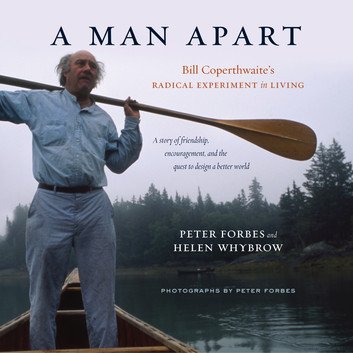
Description
A Man Apart: Bill Coperthwaite’s Radical Experiment in Living – A Complete Synopsis
Introduction: Discovering Bill Coperthwaite’s Revolutionary Life
Bill Coperthwaite chose a path few were brave enough to forsake modern comforts for simplicity. He crafted a life rooted in handwork, community, and intention. This biography chronicles his extraordinary journey.
Peter Forbes and Helen Whybrow chronicle a remarkable life, showing how one man’s decisions defied orthodoxy and prompted readers to examine their own beliefs.
The book explores decades of pioneering experimentation and illustrates how Coperthwaite inspired countless seekers. His legacy endures, rendering his philosophy profoundly relevant.
Bill Coperthwaite’s Early Life and Awakening
Coperthwaite didn’t start as a radical. Growing up in ordinary circumstances, he nevertheless felt something stir within him early on. The promises of the American Dream soon came under his questioning gaze.
Significantly shaped by education, he studied at Harvard and later traveled extensively. Eye-opening experiences led him to different possibilities. Seeing other cultures, he realized how simply people could live.
His awakening came gradually but powerfully, leading him to reject materialism and consumerism. Bill Coperthwaite sought meaning beyond possessions.
The Yurt: Bill Coperthwaite’s Architectural Vision
The yurt became Coperthwaite’s signature contribution. He discovered this ancient dwelling form during his travels and adapted it for modern use, creating designs that are both beautiful and functional.
In Maine, he built his first yurt. The structure perfectly embodied his philosophy and required minimal resources and environmental impact. Through this, Bill Coperthwaite proved simple living could be elegant.
His yurts attracted widespread attention, with people coming from afar to learn his techniques. He taught workshops generously, wanting others to experience this freedom.
The design philosophy went deeper than architecture; each yurt was a statement about values. Bill Coperthwaite believed buildings should serve life, not dominate it, and ensured his structures harmonized with nature.
Life in Dickinson’s Reach, Maine
Remote coastal Maine became Coperthwaite’s chosen home at Dickinson’s Reach. The location, selected deliberately, offered isolation and natural beauty. It allowed him to fully practice his principles.
His homestead became a living laboratory where he grew food, crafted tools, and built structures. Every aspect reflected intentional choices, as Bill Coperthwaite eliminated unnecessary complexity.
Natural rhythms governed daily life. Rising with the sun, working with his hands, and welcoming visitors seeking wisdom, he built his home into an informal school.
The property demonstrated sustainable living, showing what self-sufficiency could achieve. Bill Coperthwaite proved modern conveniences weren’t essential, finding happiness in simpler sources.
Bill Coperthwaite’s Philosophy of Handcraft
At the core of his philosophy sat handicraft. By making things, he believed, people connected to reality. Deep satisfaction came from this work, as mass production could not offer a similar level of fulfillment.
He mastered numerous traditional skills:
- Woodworking and furniture making.
- Basket weaving and fiber arts
- Tool crafting and metalwork
- Building and construction
- Food preservation and gardening
Each skill taught important lessons and required patience. Bill Coperthwaite found meditation in manual work, making his hands instruments of philosophy.
He deliberately rejected power tools, opting for hand tools only. This slowed the process and deepened his connection to materials.
Quality mattered more than quantity. He created beautiful, lasting objects, and each piece carried his values, becoming a teaching tool.
Education and Mentorship Approach
Teaching became Coperthwaite’s calling as he welcomed apprentices and freely shared knowledge. His educational philosophy was revolutionary.
Disappointment in traditional schooling led him to develop alternative methods. Learning, Bill Coperthwaite believed, should be experiential. Essential skills, he maintained, could not come from books alone.
His apprentices lived alongside him, working, eating, and learning together. This immersive approach transformed people as students absorbed values through daily practice.
He taught by example, making his life the curriculum. Bill Coperthwaite demonstrated rather than lectured, showing actions that spoke louder than words.
Hundreds of people studied with him, and many went on to teach others. His influence spread through these networks, with his legacy multiplying exponentially.
Bill Coperthwaite’s Social Vision
Coperthwaite envisioned transformed communities based on small-scale living. Mega-cities destroyed the human connection.
Intentional communities based on cooperation received his advocacy. Members would share resources and skills, forming what Bill Coperthwaite saw as humanity’s future.
His vision included economic alternatives, so he rejected capitalism’s assumptions. Money shouldn’t dominate relationships; barter and gift economies made more sense to him.
He practiced what he preached, welcoming all visitors to his homestead and sharing meals and shelter freely. Bill Coperthwaite embodied generous living.
Political activism didn’t interest him much, but his lifestyle was profoundly political. He believed personal choices created change, making living a revolutionary action.
Relationships and Personal Life
Coperthwaite’s personal life was complex. He never married or had children. Moreover, he chose solitude over a conventional family. This decision was deliberate and philosophical.
He formed deep friendships nonetheless, and many people loved and admired him. His warmth attracted genuine connections, proving Bill Coperthwaite wasn’t a cold hermit.
Women played important roles in his life, but romantic relationships remained complicated. He sometimes struggled with intimacy, and his radical choices created barriers.
He valued community over nuclear family, seeing everyone as potential kin. Bill Coperthwaite created chosen family networks; blood ties weren’t everything.
His solitude served his work, allowing deep contemplation. He could focus on his mission, and personal sacrifice enabled greater contributions.
Challenges and Contradictions in Bill Coperthwaite’s Life
The biography doesn’t romanticize its subject. Forbes and Whybrow honestly show contradictions, revealing Coperthwaite’s struggles and failures. He wasn’t a perfect sage.
Problems sometimes arose from his idealism. As practical matters got neglected, Coperthwaite could be impractical. Pure philosophy did not always work smoothly.
Much was demanded from apprentices. Overwhelming standards were hard for some, and not everyone thrived. His environment did not suit all.
Financial challenges persisted throughout his life, and he sometimes depended on others’ generosity. Complete self-sufficiency remained elusive, as reality complicated his ideals.
He could be stubborn and inflexible, making compromise difficult. Bill Coperthwaite held firm to his principles, a strength that was also a weakness.
The Authors’ Approach and Perspective
Peter Forbes knew Coperthwaite personally and brings insider knowledge to the narrative. His affection for the subject shows, but he maintains critical distance.
A complementary perspective comes from Helen Whybrow. Together, the authors create balanced portraiture and an engaging, accessible writing style. The book reads like a novel.
They conducted thorough research, including rich detail. Coperthwaite’s life emerges vividly, allowing readers to feel they know him personally.
The authors contextualize his choices historically and connect him to broader movements. The back-to-the-land movement influenced him significantly, and he influenced these movements in return.
Careful exploration of philosophical underpinnings clarifies Coperthwaite’s motivations. Logical sense guides his actions, building a coherent life.
Legacy and Contemporary Relevance
Coperthwaite died in 2009, but his influence continues to grow. His ideas resonate with new generations, and climate change makes his vision urgent.
His yurts remain popular worldwide, with people still building from his designs. Bill Coperthwaite’s architectural legacy endures as simple living attracts more interest.
The book has inspired many readers, serving as a gateway to alternative possibilities. People discover new paths through his story, and some make radical life changes.
His critique of consumerism feels prophetic, and his warnings about technology seem prescient. Bill Coperthwaite anticipated modern problems, with his solutions deserving serious consideration.
Young people especially connect with Coperthwaite’s message. Seeking meaning beyond materialism, they find guidance in his example. Simplicity holds special appeal for overwhelmed generations.
Key Themes in A Man Apart
Several major themes emerge throughout the book. Moreover, these ideas interconnect and reinforce each other. The authors weave them skillfully together.
Simplicity as liberation: Bill Coperthwaite found freedom through reduction. Fewer possessions meant more autonomy. Additionally, simplicity clarified what truly mattered.
Handcraft as spiritual practice: Making things by hand was a form of meditation. Furthermore, it connected him to deeper realities. Therefore, craft became his religion.
Community over individualism: He rejected isolated nuclear families. Moreover, he envisioned cooperative living arrangements. Humans needed each other fundamentally.
Education through experience: Book learning had severe limitations. Therefore, hands-on practice was essential. Bill Coperthwaite taught through doing.
Sustainability before it was trendy: He lived ecologically decades early. Moreover, he proved that low-impact living was possible. His example remains instructive today.
Why Read This Biography?
This book offers more than historical interest. Moreover, it provides practical inspiration. Readers gain concrete ideas for change. Therefore, it’s both philosophical and applicable.
The writing is beautiful and engaging. Furthermore, the story moves quickly. You won’t get bored with academic dryness. The narrative flows naturally.
It challenges comfortable assumptions. Additionally, it questions the foundations of modern life. Bill Coperthwaite forces readers to think deeply. His example is provocative.
The book includes practical information. Therefore, readers can apply his techniques. Yurt-building instructions appear throughout. Moreover, his craft methods are explained.
It’s ultimately hopeful and empowering. Furthermore, it shows that individuals can make a difference. One person’s choices ripple outward significantly. Therefore, your life matters too.
Conclusion: Bill Coperthwaite’s Enduring Message
Bill Coperthwaite lived an extraordinary life. He demonstrated that alternatives always exist. Moreover, he proved simplicity could be rich. His radical experiment succeeded beautifully.
The biography captures his essence wonderfully. Forbes and Whybrow honor their subject respectfully. Furthermore, they share their gifts with readers. This book is their generous offering.
His message remains vitally important today. Therefore, we should listen carefully. Bill Coperthwaite saw clearly what we’re losing. Moreover, he showed what we could gain.
The book invites personal reflection. Additionally, it challenges readers to act. What will you change in your life? Furthermore, how will you live differently?
His legacy lives through those he influenced. Moreover, it continues through this book. Therefore, reading it extends his impact. You become part of his story.
Bill Coperthwaite proved that another world is possible. He built it with his own hands. Furthermore, he invited others to join him. His door remains open through these pages.



Reviews
There are no reviews yet.