

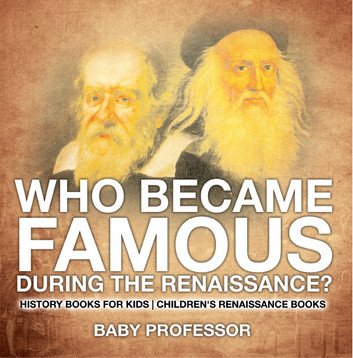
Description
Who Became Famous during the Renaissance? Discover History’s Greatest Geniuses for Kids
Introduction: Meet the Amazing People Who Became Famous during the Renaissance
The Renaissance was an extraordinary time in history when creativity exploded across Europe. Many remarkable people became famous during the Renaissance for their incredible talents and achievements. Moreover, these geniuses changed art, science, literature, and how people thought about the world. This exciting period lasted from about 1300 to 1600, primarily in Italy and beyond.
Who became famous during the Renaissance? Artists, inventors, scientists, writers, and thinkers all rose to prominence. Furthermore, their work still influences our lives today in countless important ways. Children will discover that Renaissance famous people weren’t just talented—they were curious, hardworking, and brave. They dared to ask questions, challenge old ideas, and create something entirely new.
Baby Professor’s e-book introduces young readers to these fascinating historical figures engagingly. Kids will learn why the Renaissance was called a “rebirth” of learning and culture. Additionally, they’ll understand how ordinary people became extraordinary through dedication and passion. This book makes history come alive with exciting stories about real people’s achievements.
The Renaissance produced more famous geniuses than almost any other period in history. These individuals excelled in multiple fields, not just one specific area of expertise. Therefore, children learn that being curious about many subjects leads to greatness. The people who became famous during the Renaissance prove that learning is an adventure.
What Made the Renaissance Special and Different?
The Renaissance began in Italy during the 1300s and spread throughout Europe gradually. The word “Renaissance” means “rebirth” in French, referring to renewed interest in learning. Moreover, people rediscovered ancient Greek and Roman knowledge that had been forgotten for centuries. This rediscovery sparked incredible creativity, innovation, and artistic expression across all disciplines.
Before the Renaissance, the Middle Ages focused heavily on religion and tradition exclusively. People rarely questioned authority or explored new ideas independently and freely. Furthermore, most knowledge was controlled by the Church and available only to priests. The Renaissance changed this dramatically by encouraging individual thinking, creativity, and scientific exploration.
Several factors made the Renaissance possible and helped it flourish throughout Europe. The printing press, invented around 1440, allowed books to spread quickly and widely. Additionally, wealthy families like the Medici in Florence supported artists and scholars financially. Trade brought new ideas from distant lands, inspiring Europeans to think differently.
Renaissance thinkers believed in humanism, which emphasized human potential and individual achievement. They studied subjects like art, literature, history, philosophy, and science with equal enthusiasm. Therefore, the Renaissance produced well-rounded individuals who excelled in multiple fields simultaneously. This period celebrated human creativity, intelligence, and the pursuit of knowledge passionately.
Children will understand that the Renaissance wasn’t just about famous people alone. It represented a complete shift in how Europeans thought about themselves and the world. Moreover, it laid the foundation for modern science, art, and democratic thinking today. The Renaissance shows kids that ideas can change the world dramatically and permanently.
Renaissance Artists Who Became World-Famous Masters
Many artists became famous during the Renaissance for creating breathtaking paintings and sculptures. These masters developed new techniques that made art look incredibly realistic and beautiful. Furthermore, they studied anatomy, perspective, and light to perfect their craft meticulously. Their artwork still hangs in museums where millions of people admire it annually.
Leonardo da Vinci became one of the most famous Renaissance artists ever. He painted the Mona Lisa and The Last Supper, two of history’s most recognized artworks. Additionally, Leonardo was also an inventor, scientist, and engineer who studied everything curiously. His diverse talents made him the ultimate “Renaissance man” who excelled at everything.
Michelangelo Buonarroti created magnificent sculptures and painted the Sistine Chapel ceiling in Rome. His statue of David shows incredible skill in carving marble into lifelike human form. Moreover, Michelangelo spent four years painting biblical scenes on the chapel ceiling overhead. He worked lying on his back on scaffolding, demonstrating remarkable dedication and perseverance.
Raphael Sanzio painted beautiful religious scenes and portraits with perfect harmony and balance. His School of Athens fresco shows ancient philosophers gathered together in discussion thoughtfully. Furthermore, Raphael became famous for his gentle, graceful style that influenced countless artists. He died young at 37, yet his artistic legacy remains powerful and influential.
Donatello revolutionized sculpture by creating the first free-standing nude statue since ancient times. His bronze David statue shows a young hero standing confidently after defeating Goliath. Additionally, Donatello’s work inspired other sculptors to explore human anatomy and emotion deeply. These Renaissance artists proved that creativity combined with technical skill produces timeless masterpieces.
Famous Renaissance Artists Children Will Discover:
- Leonardo da Vinci – Painter, inventor, and scientist who created the Mona Lisa
- Michelangelo – Sculptor and painter who carved David and painted the Sistine Chapel
- Raphael – Master painter known for beautiful, harmonious religious scenes and portraits
- Donatello – Revolutionary sculptor who created lifelike bronze and marble statues
- Sandro Botticelli – Artist famous for The Birth of Venus and mythological paintings
- Titian – Venetian painter who mastered color and created dramatic, emotional artwork
Renaissance Scientists and Inventors Who Changed the World
Scientists and inventors also became famous during the Renaissance for groundbreaking discoveries and innovations. These thinkers challenged old beliefs and used observation and experimentation to understand nature. Moreover, they laid the foundation for modern science by asking questions and testing ideas. Their courage to challenge authority sometimes put them in serious danger from the Church.
Galileo Galilei revolutionized astronomy by using telescopes to study the night sky carefully. He discovered Jupiter’s moons and observed that Earth orbits the Sun, not vice versa. Furthermore, Galileo’s observations contradicted Church teachings, leading to his trial and house arrest. Despite persecution, he continued his scientific work, proving that evidence matters more than tradition.
Nicolaus Copernicus proposed that the Sun, not Earth, was the center of the universe. This heliocentric theory contradicted centuries of accepted belief and religious teaching completely. Additionally, Copernicus waited until near death to publish his findings, fearing persecution. His work began a scientific revolution that changed how humans understand their place.
Andreas Vesalius transformed medicine by carefully dissecting human bodies and documenting his findings. He wrote detailed anatomy books with accurate illustrations that corrected ancient errors and misconceptions. Moreover, Vesalius proved that direct observation beats blindly accepting old authorities’ claims. His work made surgery and medicine more scientific, effective, and based on facts.
Johannes Gutenberg invented the printing press with movable type around 1440 in Germany. This invention allowed books to be produced quickly and cheaply for the first time. Furthermore, the printing press spread knowledge rapidly throughout Europe, making education more accessible. Gutenberg’s invention was arguably the most important technological advancement of the entire Renaissance.
These Renaissance scientists and inventors showed incredible bravery by challenging accepted beliefs courageously. They risked their reputations, freedom, and sometimes lives to pursue truth and knowledge. Therefore, children learn that scientific progress requires courage, curiosity, and dedication to evidence. The people who became famous during the Renaissance for science changed humanity’s understanding forever.
Renaissance Writers and Thinkers Who Shaped Ideas
Writers and philosophers became famous during the Renaissance for creating literature that still matters. These thinkers explored human nature, politics, morality, and society through their powerful words. Moreover, they wrote in everyday languages instead of only Latin, making literature accessible. Their ideas influenced how people thought about government, religion, and individual rights significantly.
William Shakespeare became the most famous playwright and poet in the English language. He wrote 37 plays and 154 sonnets exploring love, power, jealousy, and human nature. Furthermore, Shakespeare invented thousands of words and phrases we still use in English today. His plays are performed worldwide, proving that great storytelling transcends time and culture.
Niccolò Machiavelli wrote “The Prince,” a controversial book about political power and leadership. He argued that rulers sometimes must act ruthlessly to maintain control and stability. Additionally, Machiavelli’s realistic approach to politics shocked readers who expected moral idealism instead. His name became synonymous with cunning political strategy, though his intentions were misunderstood.
Dante Alighieri wrote “The Divine Comedy,” an epic poem describing a journey through Hell. He wrote in Italian instead of Latin, making literature accessible to ordinary people. Moreover, Dante’s vivid descriptions of the afterlife influenced art, literature, and religious thinking. His work proved that vernacular languages could express complex, beautiful ideas as effectively.
Desiderius Erasmus promoted education, religious reform, and humanist values throughout Europe through writing. He criticized Church corruption while remaining a devout Catholic throughout his entire life. Furthermore, Erasmus believed that education and reason could improve society and human behavior. His writings influenced the Protestant Reformation and modern educational philosophy significantly and permanently.
These Renaissance writers and thinkers became famous for challenging people to think differently. They questioned authority, explored human psychology, and imagined better societies through their words. Therefore, children learn that ideas expressed through writing can change the world powerfully. The Renaissance proved that the pen truly is mightier than the sword.
Renaissance Explorers Who Discovered New Worlds
Explorers became famous during the Renaissance for voyaging to unknown lands and seas. These brave adventurers sailed across dangerous oceans seeking trade routes, wealth, and knowledge. Moreover, their discoveries connected continents and changed world history forever and dramatically. The Age of Exploration overlapped with the Renaissance, sharing its spirit of curiosity.
Christopher Columbus sailed west from Spain in 1492, seeking a route to Asia. Instead, he reached the Americas, though he never realized he’d found new continents. Furthermore, Columbus’s voyages began European colonization of the Americas with profound consequences. His expeditions changed world history, though his legacy remains controversial and debated today.
Vasco da Gama became the first European to reach India by sailing around Africa. His successful voyage in 1498 opened direct trade routes between Europe and Asia. Additionally, da Gama’s journey proved that ocean travel could connect distant continents profitably. Portuguese explorers dominated early exploration, establishing a vast trading empire across oceans.
Ferdinand Magellan led the first expedition to circumnavigate the globe, proving Earth’s roundness. Though Magellan died during the journey, his crew completed the historic voyage successfully. Moreover, this expedition demonstrated the true size of Earth and the Pacific Ocean. It showed that determination and navigation skills could conquer seemingly impossible challenges bravely.
Amerigo Vespucci explored South America’s coast and realized it was a separate continent. The Americas were named after him because of his geographical insights and observations. Furthermore, Vespucci’s letters describing the “New World” became bestsellers throughout Europe. His work helped Europeans understand that Columbus had discovered entirely new lands.
These Renaissance explorers expanded human knowledge of geography and connected distant civilizations together. Their voyages had both positive and negative consequences for indigenous peoples they encountered. Therefore, children learn that historical figures are complex, with achievements and flaws simultaneously. The explorers who became famous during the Renaissance changed the world’s map forever.
Famous Renaissance Explorers and Their Discoveries:
- Christopher Columbus – Sailed to the Americas in 1492, beginning European colonization
- Vasco da Gama – First European to reach India by sea around Africa
- Ferdinand Magellan – Led the first expedition to circumnavigate the entire globe
- Amerigo Vespucci – Realized the Americas were separate continents, not Asia
- John Cabot – Explored North America’s coast for England in the 1490s
- Hernán Cortés – Conquered the Aztec Empire in Mexico for Spain
Renaissance Leaders and Patrons Who Supported Genius
Powerful leaders and wealthy patrons became famous during the Renaissance for supporting artists and scholars. These individuals provided money, protection, and encouragement to creative geniuses throughout Europe. Moreover, without their financial support, many Renaissance masterpieces would never have been created. They understood that supporting art and learning brought prestige, beauty, and cultural advancement.
The Medici family of Florence became the most famous Renaissance patrons in history. They were wealthy bankers who ruled Florence and supported countless artists and thinkers. Furthermore, the Medici commissioned artwork, built libraries, and funded academies for studying philosophy. Their patronage made Florence the birthplace and center of the Italian Renaissance.
Lorenzo de’ Medici, called “Lorenzo the Magnificent,” personally supported Leonardo da Vinci and Michelangelo. He created an academy where young artists studied ancient sculptures and learned their craft. Additionally, Lorenzo wrote poetry himself and hosted intellectual discussions at his palace regularly. His leadership made Florence a cultural capital that attracted talent from everywhere.
Pope Julius II commissioned Michelangelo to paint the Sistine Chapel ceiling and design buildings. He also hired Raphael to paint frescoes in the Vatican’s papal apartments beautifully. Moreover, Julius II’s ambitious building projects transformed Rome into a Renaissance showcase. His patronage, though expensive, created some of history’s greatest artistic treasures permanently.
Isabella d’Este became one of the Renaissance’s most important female patrons and collectors. She commissioned artwork, collected antiquities, and corresponded with leading intellectuals throughout Europe. Furthermore, Isabella’s court in Mantua became a center of culture, music, and learning. She proved that women could be influential cultural leaders during the Renaissance.
These Renaissance leaders and patrons understood that supporting creativity benefits entire societies permanently. They invested in beauty, knowledge, and human potential rather than just military power. Therefore, children learn that supporting artists and thinkers is as important as any achievement. The patrons who became famous during the Renaissance enabled genius to flourish magnificently.
Renaissance Musicians and Composers Who Created Beautiful Sounds
Musicians and composers became famous during the Renaissance for creating new musical styles. They developed polyphony, where multiple melodies play simultaneously in harmony and counterpoint. Moreover, Renaissance music was performed in churches, courts, and homes throughout Europe. This period transformed music from simple chants into complex, beautiful compositions.
Giovanni Pierluigi da Palestrina composed sacred music that became the standard for Catholic worship. His masses and motets featured clear, flowing melodies that expressed religious devotion beautifully. Furthermore, Palestrina’s music influenced church music for centuries after his death in 1594. The Catholic Church considered his style the perfect model for sacred composition.
Josquin des Prez became one of the most admired composers of the entire Renaissance. His music combined technical mastery with emotional expression that moved listeners deeply and profoundly. Additionally, Josquin’s compositions spread throughout Europe thanks to music printing technology advances. Other composers studied his work to learn proper technique and expressive musical writing.
Thomas Tallis composed music for the English royal court during a turbulent religious period. He wrote both Catholic and Protestant church music as England’s official religion changed. Moreover, Tallis’s compositions showed incredible versatility and adaptation to different religious requirements skillfully. His music remains performed and recorded by choirs worldwide today regularly.
Renaissance musicians also developed new instruments and improved existing ones significantly and permanently. The lute, viol, recorder, and harpsichord became popular during this creative period. Furthermore, music printing allowed compositions to spread quickly, creating an international musical culture. Amateur musicians in homes could now play the same pieces performed in courts.
These Renaissance musicians proved that music is as important as visual art. Their compositions expressed human emotions, religious devotion, and intellectual complexity through organized sound. Therefore, children learn that creativity takes many forms beyond painting and sculpture alone. The musicians who became famous during the Renaissance created beauty that still resonates today.
Women Who Became Famous during the Renaissance
Women faced significant barriers during the Renaissance, yet some became famous despite limitations. Society expected women to focus on family rather than public achievement or careers. Moreover, women couldn’t attend universities or join professional guilds in most European cities. Despite these obstacles, exceptional women made important contributions to Renaissance culture and learning.
Sofonisba Anguissola became a successful portrait painter, rare for women in her time. She studied art seriously and gained international recognition for her skillful, sensitive portraits. Furthermore, King Philip II of Spain invited her to be a court painter. Her success inspired other women to pursue artistic careers despite societal disapproval.
Artemisia Gentileschi became one of the most accomplished painters of the entire Baroque period. She painted powerful biblical scenes featuring strong female characters and dramatic action scenes. Additionally, Artemisia overcame personal tragedy and discrimination to establish a successful artistic career. Her work proved that women could paint as skillfully as any male artist.
Isabella d’Este, mentioned earlier, became famous for her political skill and cultural patronage. She ruled Mantua effectively when her husband was captured in war, showing leadership. Moreover, Isabella negotiated with popes, kings, and emperors to protect her city-state. She proved that women could be effective political leaders and cultural influencers simultaneously.
Christine de Pizan became one of Europe’s first professional female writers in history. She wrote poetry, political treatises, and books defending women’s capabilities and intelligence strongly. Furthermore, Christine supported herself and her family through writing after her husband died. Her work challenged medieval attitudes about women’s intellectual abilities and potential contributions.
These remarkable women became famous during the Renaissance by refusing to accept limitations imposed. They pursued their talents despite opposition, discrimination, and lack of formal educational opportunities. Therefore, children learn that determination can overcome even significant societal barriers and prejudices. These women’s achievements inspire young girls to pursue their dreams regardless of obstacles.
How Renaissance Famous People Changed the World Forever
The people who became famous during the Renaissance transformed European civilization completely and permanently. Their achievements in art, science, literature, and exploration shaped the modern world fundamentally. Moreover, they established principles like observation, experimentation, and individual creativity that we value today. The Renaissance proved that human potential is nearly limitless when curiosity is encouraged.
Renaissance artists developed techniques like perspective, realistic anatomy, and emotional expression in painting. These innovations made art more lifelike, beautiful, and emotionally powerful than ever before. Furthermore, their masterpieces still inspire artists, students, and museum visitors worldwide every single day. The artistic standards they established continue influencing visual culture across all media today.
Renaissance scientists challenged ancient authorities and established the scientific method’s foundations through experimentation. They proved that observation and evidence matter more than tradition or religious authority alone. Additionally, their discoveries about astronomy, anatomy, and physics began the Scientific Revolution completely. Modern science exists because Renaissance thinkers dared to question everything and test ideas.
Renaissance writers created literature that explored human psychology, politics, and morality with unprecedented depth. Their works in vernacular languages made literature accessible beyond educated elites exclusively speaking Latin. Moreover, their ideas about government, individual rights, and human nature influenced democratic movements later. The Renaissance showed that ideas expressed through writing can transform societies permanently.
Renaissance explorers connected continents and created the first truly global civilization in history. Their voyages brought different cultures into contact, though often with tragic consequences for indigenous peoples. Furthermore, the exchange of goods, ideas, and technologies between continents accelerated dramatically afterward. The world became interconnected in ways that continue shaping our globalized society today.
The Renaissance famous people proved that one individual can make extraordinary differences through dedication. They showed that curiosity, hard work, and courage to challenge conventions lead to greatness. Therefore, children learn that they too can contribute something meaningful to the world. The Renaissance legacy encourages young people to explore their talents and pursue knowledge passionately.
Why Learning About Renaissance Famous People Matters for Kids
Studying who became famous during the Renaissance teaches children important lessons about human potential. These historical figures show that ordinary people can achieve extraordinary things through dedication. Moreover, kids learn that being curious about many subjects makes you smarter and creative. The Renaissance proves that asking questions and challenging old ideas leads to progress.
Renaissance famous people demonstrate the value of combining different interests and skills together. Leonardo da Vinci was both an artist and scientist, making him better at both. Furthermore, Renaissance thinkers believed that well-rounded education produces the most capable, creative individuals. This lesson encourages children to explore diverse subjects rather than limiting themselves unnecessarily.
Learning about Renaissance achievements inspires children to pursue their own talents and interests. When kids see what humans accomplished centuries ago, they realize their own potential. Additionally, Renaissance stories show that persistence, practice, and passion lead to mastery and success. These historical examples provide role models who overcame obstacles to achieve greatness permanently.
The Renaissance also teaches children about the importance of supporting creativity and learning. Patrons like the Medici family enabled genius to flourish by providing resources and encouragement. Moreover, societies that value education, art, and science produce the most innovation and progress. Kids learn that supporting others’ talents benefits everyone in the community collectively.
Understanding Renaissance history helps children appreciate the art, science, and ideas they encounter today. They’ll recognize famous paintings, understand scientific principles’ origins, and appreciate literary classics more deeply. Therefore, Renaissance education provides cultural literacy that enriches their entire lives going forward. It connects past achievements to present knowledge in meaningful, exciting ways for learners.
Perfect for Young History Enthusiasts and Future Scholars
Baby Professor designed this e-book specifically for children curious about history and famous people. The content is age-appropriate, engaging, and educational without overwhelming young minds unnecessarily or boringly. Moreover, the book uses simple vocabulary that elementary students can understand independently or with help. Parents can read it aloud or kids can explore it themselves confidently.
The book includes colorful illustrations, portraits, and reproductions of famous Renaissance artworks throughout. Visual learning helps children remember information better and stay engaged with historical content. Furthermore, seeing actual Renaissance paintings, sculptures, and inventions makes history feel real and exciting. Kids can observe the details that made these achievements so special and remarkable.
Each section builds knowledge gradually, introducing one group of famous people at a time. The book balances fun facts with educational content in an engaging, exciting manner. Additionally, it encourages children to think about how these historical figures’ work affects us today. This approach develops critical thinking skills alongside historical knowledge and cultural appreciation simultaneously.
Teachers and homeschooling parents will find this resource incredibly valuable for Renaissance unit planning. The content covers art history, scientific history, literature, and exploration all in one place. Furthermore, it provides discussion points for classroom conversations or family reading time together regularly. The book makes Renaissance history accessible and interesting to elementary and middle school students.
Inspiring the Next Generation of Artists, Scientists, and Thinkers
Reading about who became famous during the Renaissance plants seeds of curiosity in young minds. Children see that people from centuries ago faced challenges but achieved greatness anyway. Moreover, they learn that creativity, intelligence, and hard work matter more than circumstances or background. Renaissance famous people prove that anyone can make important contributions to the world.
The book demonstrates that making mistakes and experimenting are essential parts of learning anything. Renaissance scientists conducted experiments that sometimes failed before discovering truth through persistence and observation. However, they kept trying, learning, and refining their ideas throughout their entire lives. Therefore, kids learn that failure is just part of the journey to success.
Young readers discover that passion and curiosity matter more than being perfect immediately. Renaissance masters weren’t born knowing everything; they learned through years of dedicated study. Additionally, they never stopped learning, even when they became famous and successful already. Their lifelong dedication to learning inspires children to stay curious about everything always.
The book also shows children that their different interests can work together beautifully. Renaissance famous people often excelled in multiple fields, not just one narrow specialty. Furthermore, their diverse knowledge made them more creative, capable, and interesting individuals overall. Kids learn that being well-rounded is a strength that leads to innovation.
Conclusion: The Lasting Legacy of Renaissance Famous People
The people who became famous during the Renaissance remain some of history’s most accomplished individuals. Their achievements in art, science, literature, music, and exploration continue influencing our world today. Moreover, their insatiable curiosity and diverse talents make them perfect role models for children. Learning about Renaissance famous people shows kids what’s possible through dedication and passion.
Baby Professor’s e-book brings these Renaissance geniuses to life for young readers effectively. It presents their stories in an engaging, accessible way that captures children’s imaginations. Furthermore, it shows kids that learning about history can be exciting and personally relevant. The book makes Renaissance famous people feel like real individuals, not just names.
By studying who became famous during the Renaissance, children gain inspiration to explore their talents. They learn that hard work, curiosity, and persistence lead to amazing achievements and discoveries. Therefore, this book offers valuable lessons that extend far beyond history class alone. It encourages kids to observe the world carefully and think creatively about problems.
The Renaissance famous people’s lives prove that individuals can make lasting differences in civilization. Their paintings still inspire artists, their discoveries still teach scientists, and their ideas still influence thinkers. Moreover, their example shows children that learning is a lifelong adventure worth pursuing passionately. This book plants seeds that may grow into future artists, scientists, writers, and leaders.
The next time children visit a museum, read Shakespeare, or learn about the solar system, they’ll understand the Renaissance connection. They’ll know about the incredible people who became famous during the Renaissance and why they matter. Furthermore, they’ll remember that curiosity, hard work, and diverse interests lead to greatness. The Renaissance legacy continues inspiring new generations to dream big, learn everything, and change the world.
Reviews
There are no reviews yet.